Students and faculty in UW Tacoma’s Urban Studies and Civil Engineering programs turned the campus master plan into a career‑connected learning opportunity.
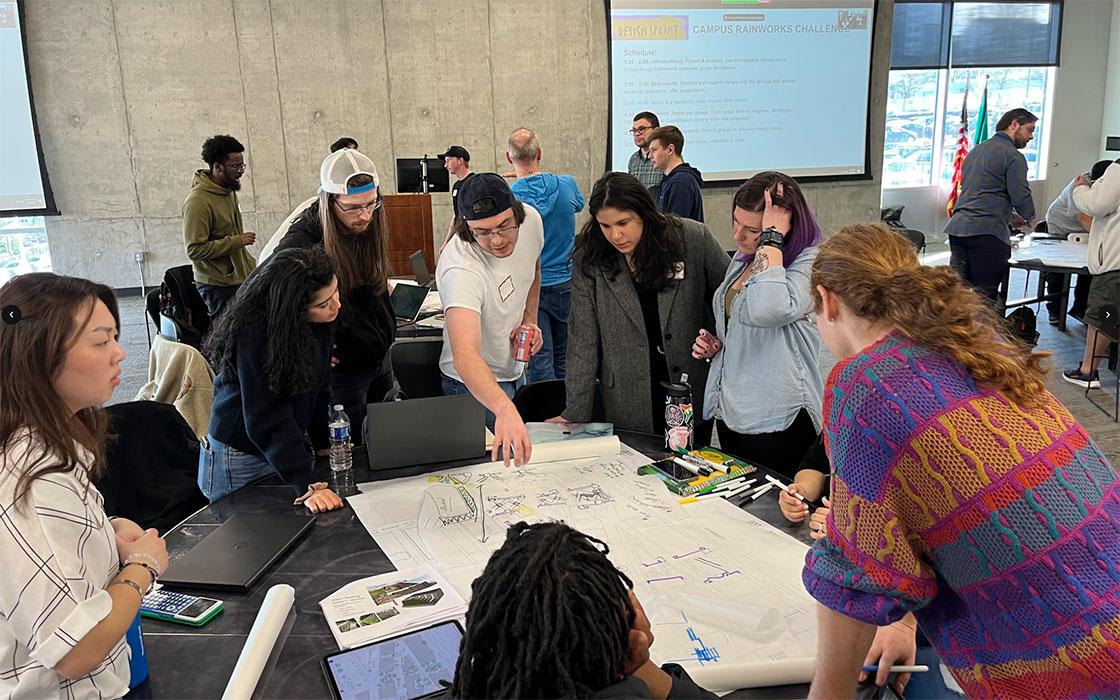
During a Design Sprint Workshop organized by faculty members Bára Šafářová and Nara Almeida, students and faculty collaborate with experts from the City of Tacoma. | Courtesy of Bára Šafářová
When it comes to connecting classroom learning to real-world situations, finding case studies that feel both relevant and meaningful can be a challenge.
For students in UW Tacoma’s Urban Studies and Civil Engineering programs, the university’s new campus master plan became more than a subject of study — it became a living project and an opportunity to help shape a place they move through every day.
Planning efforts went beyond including student voices. Through a new community-engaged course, students in UW Tacoma's urban design and civil engineering programs played a key role in the process while building skills in cross-disciplinary collaboration.
With support from a Founders Endowment Award, Bára Šafářová, Ph.D., an assistant professor in the School of Urban Studies, and Nara Almeida, D.Eng., an assistant teaching professor in the School of Engineering & Technology, teamed up to develop the course and connect it to the ongoing master planning efforts.
The experience, Šafářová said, was a learning opportunity for both the students and themselves.
“For Nara and I, we had to spend hours trying to prepare the course, because we had to find common language to understand what we mean by words like ‘design,’” she said. “It took us a while to get on the same page, and it was the same thing for the students.”
While civil engineering students explored technical solutions and learned about the social aspects involved in creating projects for communities, the urban design students led a campus-wide engagement campaign to gather feedback from their peers on what they would like to see included in the master plan.
“Because it was student-to-student relationships, they were more open and honest," said Raisa Baker, a recent UW Tacoma graduate who is now studying in UW's Master of Landscape Architecture program in Seattle. "...It was great to hear, because we were graduating seniors, so we already lived our experience through UW Tacoma. But we had freshmen who were just coming in, and there were things that they were hoping to gain.”
Along the way, students had touchpoints with a wide range of faculty and technical experts, including officials from the City of Tacoma, to ask questions and receive feedback on their ideas. This aspect, Šafářová said, enhanced the value of the experience and added depth beyond what could be achieved through a more typical theoretical project.
“For me, it was this whole new eye-opening experience," said Christy Gonzalez, a recent UW Tacoma graduate also studying landscape architecture. "I think it helped to reel in my designs a little bit better and grounded me in reality a little more ... I was given a lot more perspective, and I really appreciated that.”
Engaging with the campus master plan also gave students a chance to gain experience working with a subject in which they are the “expert users.” This personal connection, combined with the close-knit nature of the campus community, provided them with an opportunity to develop thoughtful ideas that would leave a lasting impact.
Ideas inspired by the ‘expert users’ themselves
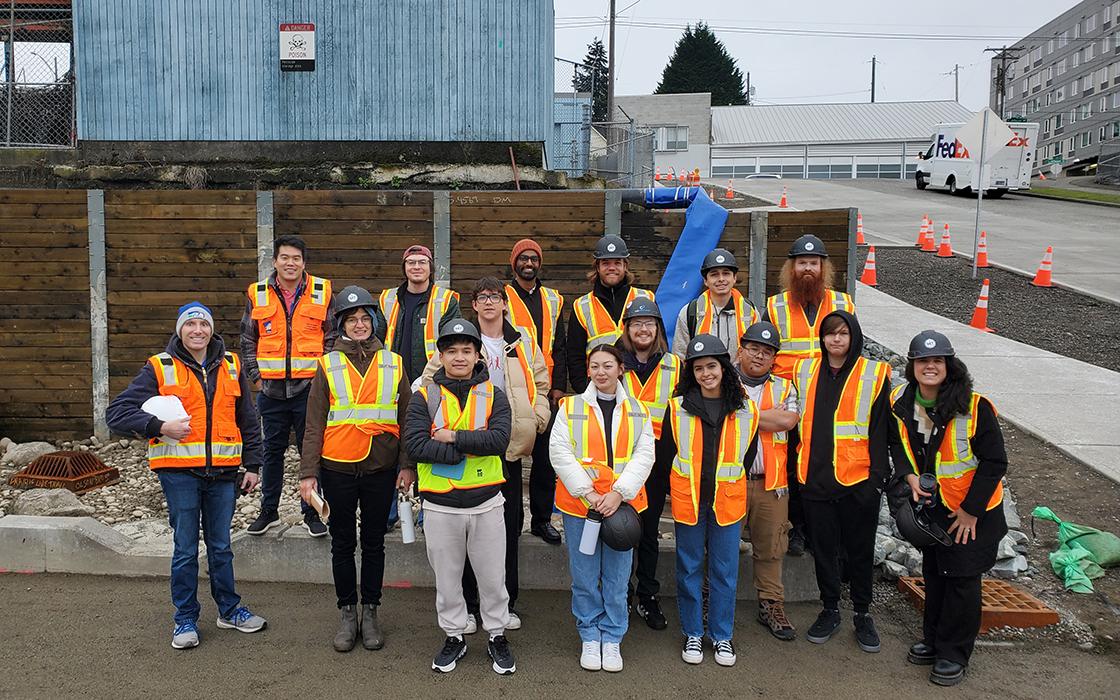
As part of the collaborative capstone course, civil engineering and urban design students toured the Prairie Line Trail project with Brian Wang from Tacoma Public Works. | Courtesy of Nara Almeida
Throughout their capstone projects, students were challenged to explore solutions for areas of the campus that were meaningful to them.
One project idea emerged when students discovered that traveling up the winding ramps takes three times longer than climbing the grand staircase. The ramps, installed to address accessibility challenges posed by downtown Tacoma’s steep, uphill terrain, prompted students to explore ways to make the journey easier and more inclusive for everyone.
A proposed solution that made its way into the master plan is an autonomous trolley system along South 19th Street that could offer a more practical way for people to travel across campus.
For Kari Lau, a recent graduate of UW Tacoma's civil engineering program whose project inspired the idea for the trolley, this experience allowed her to develop skills she would later use in her summer internship-turned-full-time job in civil engineering.
“I think that's the best part about this whole (course), because we were able to go through those motions and be able to see for the first time — is this a field that we actually want to work in? Is engineering something I actually want to go into, if this is what it's like?" Lau said. "It really built perspective in more of an individual sense as well.”
This story is part four of a five-part series on the development of UW Tacoma’s new Campus Master Plan. Keep reading to explore what’s next for the university and some of the early changes expected to unfold on campus over the next several years.