At home on campus
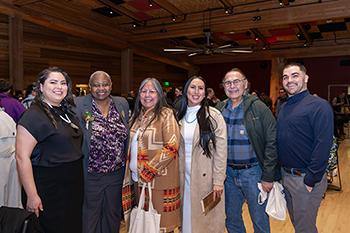
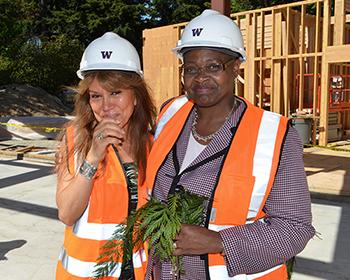
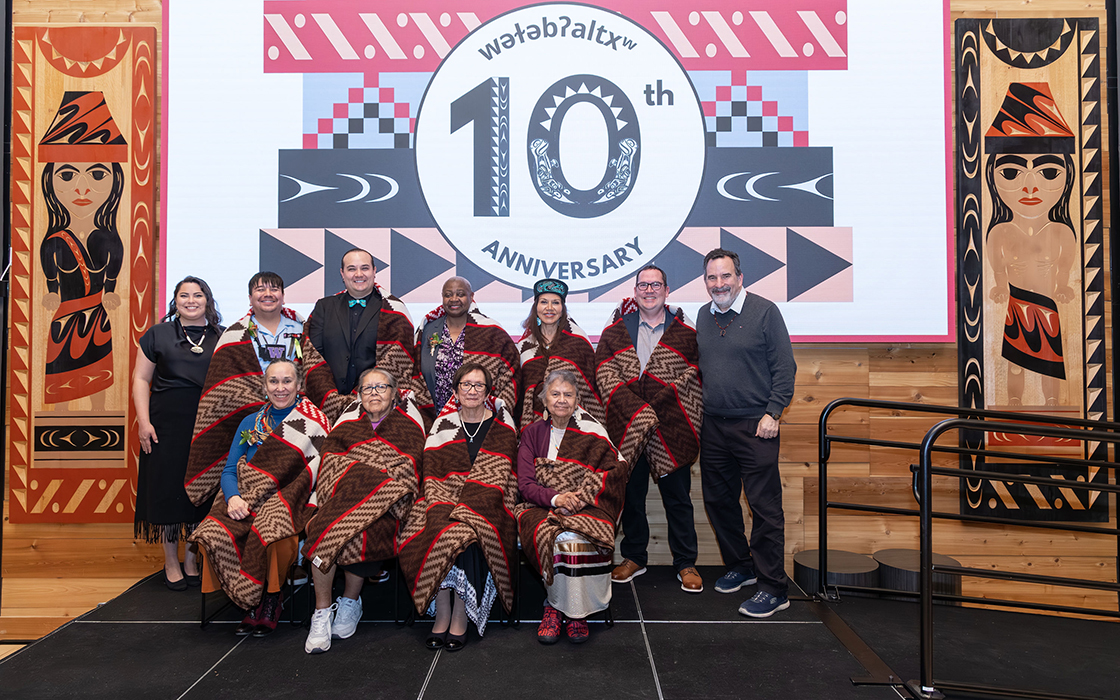
This spring, the flourishing longhouse-style wǝɫǝbʔaltxʷ - Intellectual House celebrated its 10th anniversary as a center for Native Indigenous student cultural life on the University of Washington’s Seattle campus by honoring 10 people who helped bring that dream and more to life, including UW Tacoma Chancellor Sheila Edwards Lange.
"It was extremely difficult to select just 10 — there are so many community members, current and former, that could be acknowledged," says Intellectual House Director Chenoa Henry. "As the then Vice President of the Office of Minority Affairs and Diversity (OMAD), Dr. Lange was a prominent leader early on and at the forefront, and she continues to be a part of uplifting Native and Indigenous communities at UW Tacoma."
Dr. Danica Sterud Miller, a member of the Puyallup Tribe and an associate professor at UW Tacoma, agrees. “There was a group of very active, amazing American Indian scholars who were at the forefront of this work, and that energy moved in many directions — the American Indian Studies Department, the Center for American Indian and Indigenous Studies (CAIIS), Intellectual House — and from day one at UW Tacoma, Chancellor Lange has been a champion and supporter of American Indian and Indigenous faculty, staff and students, as well as a partner and a thought leader.”
Blending university process with tribal wisdom
The vision for Intellectual House had been around for over 30 years before Lange was tasked with revisiting the idea, not long after beginning her role at OMAD. She attributes the success of the effort to a group of open-minded people being in the right place at the right time.
"I was new enough in my job and naive enough to think that I could figure it out. I started asking questions about what had happened the two or three times they had tried before," she says.
"She really administered the process to get it done," says UW Regent and Suquamish Tribal Chairman Leonard Forsman. "She was very encouraging, getting the advocates organized and on track and making meaningful action, and when it did get completed, it was a wonderful time."
A resilient community in action
Growing up in Suquamish on the Port Madison Indian Reservation, Forsman always looked to the University of Washington with admiration. "The UW is an institution of the Salish Sea and Puget Sound area," he says. "It was a place you esteemed to be associated with, let alone attend."
In 1981, after a short time at a school in California that didn't feel like home, Forsman transferred to UW's Seattle campus. There, he found others to learn from. "There were some American Indian Studies classes and American Indian Art classes that I took, because I had a strong interest in that," he says. "I got to know a lot of the people on campus and visiting professors that were Indian academics, like Jim Nason, Marilyn Bentz, Barbara Lane, Vi Hilbert, and in the anthropology department, Gene Hunn. I was working a part-time job with tribes on museum archives and meeting visiting professors, doing music and dance, exposed to so many influences."
Alongside these and other leaders, Forsman helped strengthen cultural reclamation efforts at UW and across Tribal communities. He remembers the growth of annual gatherings, such as the 1989 Paddle to Seattle, which evolved into the Tribal Canoe Journey, a large-scale event where Indigenous canoe families travel by traditional canoes to a host community to celebrate shared heritage and cultural traditions.
These community builders established the first UW Tribal Leadership Summit in 2007. This ongoing, annual event provides an opportunity to discuss issues of importance to American Indian and Alaska Native communities with the UW's president and other leaders.
All of these efforts would also eventually lead to the creation of the Intellectual House. "A lot of us were alumni, and the only places to meet were in classrooms," says Forsman. "We needed a place to gather that recognized the tribal culture, physically, architecturally and spiritually."
Lifting up the next generation
Successive students continued to feel this need. Attending UW decades after Forsman graduated, Henry was one of them. "While getting my bachelor's degree, I struggled significantly and dropped out before finishing," she says. "It was hard to find community when there wasn’t a space like wǝɫǝbʔaltxʷ when I was here."
Fortunately for Henry, Lange had been building relationships with tribes all over the state, attending tribal councils, and Henry's mother suggested that she reach out for guidance. "Getting Dr. Lange's advice proved to be pivotal for me," Henry says. "Through her leadership, I finished my undergraduate degree, got my master's degree, and it came full circle when I got this job."
Lange continues this effort at UW Tacoma, building on early leadership from Sharon Parker. Hired in 2007 as UW Tacoma’s first senior equity officer, Parker brought perspectives as a person of African American and Native American (Tslagi/Rappahannock) heritage and launched what is now the Native American Indigenous Education Symposium. Her late husband, Alan Parker, a citizen of the Chippewa Cree Tribal Nation, was a widely respected attorney and tribal sovereignty advocate whose work influenced the region.
UW Tacoma also has a legacy of deep partnership with the Puyallup Tribe. Before Lange arrived in 2021, Puyallup leaders, including Chairman Bill Sterud and the Tribal Council, along with Native faculty members such as Miller and Dr. Michelle Montgomery, as well as community members like Puyallup Tribe Heritage Division Manager Connie McCloud and Puyallup Elder Peggy McCloud, made steady progress.
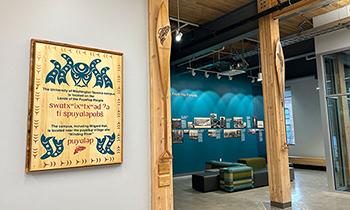
Together, they worked to ensure Indigenous knowledge, language, and culture would be visible across campus, from the new Office of Indigenous Engagement to American Indian Studies courses, and Lushootseed signage to the permanent Land Acknowledgment in Milgard Hall.
Miller notes how expansive and community-centered UW Tacoma’s Indigenous programming is. “We have several tenure-track faculty who are American Indian or Indigenous, and two of us — myself and Dr. Sara Eccleston — are Puyallup, teaching on our ancestral homelands, which is rare and something we’re very proud of.”
Strengthening infrastructure and relationships
Launched in summer 2024 and led by UW Tacoma 2020 alumnus Dr. Leander Yazzie, the Office of Indigenous Engagement at UW Tacoma is a dedicated space designed to foster connections, provide support and expand educational opportunities for Indigenous students throughout the region.
Yazzie, UW Tacoma’s tribal liaison, focuses on strengthening relationships with the six surrounding tribes — Puyallup, Muckleshoot, Suquamish, Nisqually, Chehalis, and Squaxin Island — while welcoming students from all backgrounds, including working to connect them with their affiliated tribal entities.
“It’s very exciting,” Yazzie said of the new office. “It opens the door to more opportunities for our Native students to experience and step into important spaces where they are acknowledged as the next leaders.” He emphasized that building trust with younger generations across tribes takes time and commitment.
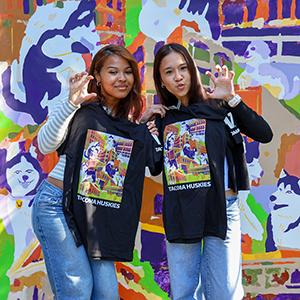
The office also supports the work of Cedar Circle — an Indigenous-identity-based student organization founded by Alexis Ozaawaashka Binesikwe Perez (‘25) — and provides a syayəʔadiʔ (Family Room) gathering space for supportive programming, as well as a place where students can study, relax and connect. Perez, a Potawatomi and Ojibwe student and U.S. Navy veteran, says the community has been life-changing: “It’s important that we have those spaces where [Indigenous students] are welcomed and have their voice.”
Momentum continues to grow through events such as the annual Native and Indigenous Higher Education Symposium — this year themed ləƛ’ax̌ʷil gʷəl lədᶻixʷqsil (to Grow and Lead). The symposium brings together high school students, scholars and educators to highlight Indigenous scholarship and inspire future leaders. This year's gathering featured two UW alums who shared their stories along with a presentation by the Cedar Circle student leadership.
Stepping into this lineage, Lange has expanded pathways and partnerships, including a first-of-its-kind Indigenous doctoral cohort, a partnership with the Muckleshoot Tribal College through the leadership of Dr. Robin Minthorn and Dr. Denise Bill. And Lange wants to do more with tribal schools.
"The link we have with the Puyallup Tribe is very strong, but we still don't have a large number of Native students," she says. "We should have more. We are small enough that students can find community and feel a sense of belonging, and we are doing that work around student retention, creating that for all students."
Pathways to a richer whole
Henry recognizes the monumental value of what they are building: “It’s good to reflect on how we got to where we are, to look at how we’re going to get to where we need to be, to be really fulfilling that commitment that the university made so many decades ago," she says. “To give Native students a place where their culture is respected and uplifted, so they feel empowered to go on to wherever they need to be.”
“Knowing that we can go from so little to having something substantial is encouraging, with more to come,” says Forsman. “These aren’t just buildings; when you represent thousands of years of occupation and relationship and stories and cultural ceremonies, you realize that this is a living resource that will be here for a long time and influence perspectives and choices far beyond our own communities.”
The Intellectual House was initially conceived as a single, comprehensive project. However, when the 2008 recession struck, it had to be strategically divided into two phases so that the dream could move forward. Phase 1 opened in 2015, and students and community members soon overflowed the space. "Phase 1 is trying to do so many different programmatic pieces that it wasn't built to do," Henry says. "We have a huge gathering hall, a small conference room, a kitchen and an admin space."
Phase 2 includes plans for student lounges and study areas, a Native art lab, multigenerational meeting space and outdoor gathering spaces. Its projected completion in 2027 will fulfill the original vision and ensure that future generations inherit the whole cultural home imagined decades ago. According to Lange, Forsman’s persistence is why Phase 2 is finally advancing.
“Leonard has that unique perspective of being there as a student when the need was so clear, then active in the planning for phase 1, and later as a regent, asking the questions that helped move phase 2 forward,” she says.
Together, she, Henry, Forsman and Yazzi are part of a much larger, sustained effort that continues to create connections across campuses, communities, generations and geographies. Lange notes the responsibility that comes with this work.
“You can’t make empty promises,” she says. “When we say we’re going to take care of students, we have to deliver.”
It is that kind of sustained commitment that is helping UW reach its full potential as a place where Native students can become the next generation of leaders and thrive.
You can learn more and support UW Tacoma's Office of Indigenous Engagement here.