

Students make 24-hour sprint to fix everyday money stress
There was a noticeable spark inside Milgard Hall as 75 students gathered for the first-ever HuskyHack, an all-day software development sprint and 24-hour fintech innovation challenge hosted by the Milgard School of Business’ Center for Business Analytics and Sound Credit Union (Sound)
The inaugural problem statement challenged teams to design and prototype an innovative digital solution that helps consumers easily organize, discover and maximize the benefits available to them, from financial products and services to memberships and loyalty programs.
In a nutshell? People have more benefits, rewards, memberships and financial opportunities than ever before, but almost no way to track or use them effectively. That’s when these tech-savvy students got to work.
A sprint toward innovation
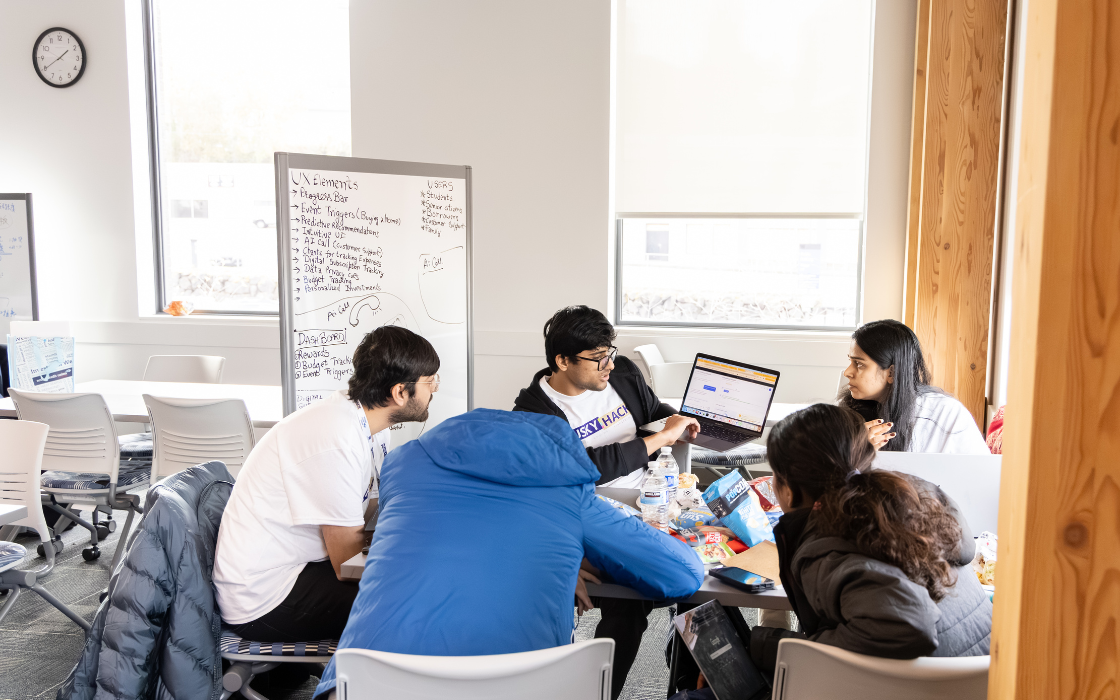
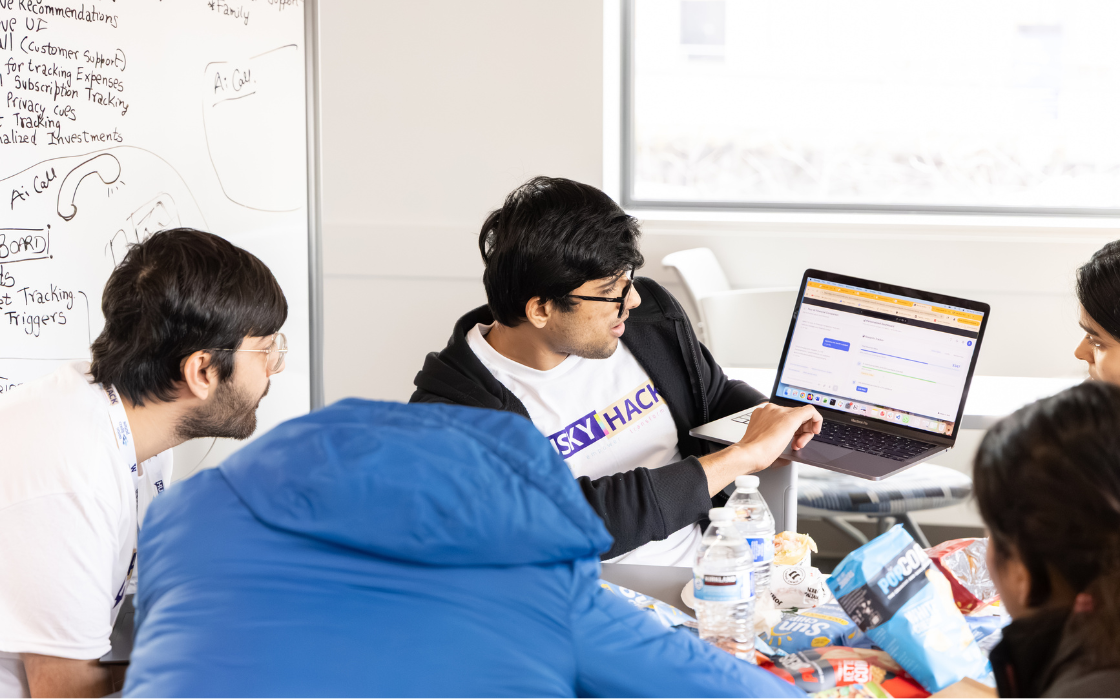
Laptops opened quickly as teams formed in tight clusters — save for a few solo competitors — sketching early concepts, comparing last-minute research and setting up makeshift workstations that stretched across tables.
All of a sudden, it was a clatter of laptop keys and the murmur of quiet brainstorming. The atmosphere blended the tension of a design sprint with the buzz of a startup launch: fast, collaborative and a little chaotic (with a healthy dose of coffee on hand).
What unfolded was one of the most dynamic student innovation events of the year.
The goal was to simplify how users access and understand their banking benefits, deliver timely reminders and personalized insights, reduce money stress and help people save money through smarter financial moves.
All in all, students were asked to rise above imagined solutions, instead creating fintech tools that could strengthen financial health for everyday consumers in an actionable way.
“Sound Credit Union came to the hackathon with a very specific problem to solve,” said Celestin Ryf, a senior studying computer science in the UW Tacoma School of Engineering and Technology (SET). “As a result, our solution looked similar to what other teams prepared, so it became key to differentiate ourselves from the competition.”
HuskyHack was born to give students hands-on experience with rapid-fire problem-solving and user-centered thinking that defines modern fintech. A natural extension of the Milgard School of Business’ mission to cultivate innovative, socially responsible business leaders, this particular competition stood out for centering a problem faced by millions: navigating scattered financial benefits, increasing awareness and making sense of rewards that often go unclaimed.
For Michael Turek, Director of the Milgard Center for Business Analytics, the experience was defined by empathy:
"This year’s problem statement pushed students to confront a financial reality that affects millions,” he explained. “People are surrounded by benefits and rewards they rarely understand, let alone fully use,” Turek said. “It was a complex challenge, because simplifying such a fragmented landscape requires not only technical skill but real empathy for user needs. What impressed us most was how teams transformed that complexity into clear, intuitive solutions.”
Statewide teams, industry leaders
Hailing from higher education institutions across Washington State, a diverse student body was represented, with a cross-section of academic backgrounds usually reserved for Silicon Valley.
Business and analytics students teamed up with software engineers, UX designers, cybersecurity majors, computer scientists and students with lived experience navigating the financial system. Competitors hailed from the University of Washington, Seattle College and Washington State University, among other schools across the state.
By bringing together students from varied backgrounds to tackle real-world financial challenges, the Milgard School gave competitors a hands-on learning opportunity that mirrors the school’s high-impact, market and community-centered priorities. Empowering students to apply technical, creative and analytical skills in a compressed, real-world setting, the HuskyHack was definitive proof that student-driven innovation can address our most pressing needs while preparing graduates to lead in the complex, rapidly evolving world of business and technology.
Judges and mentors from across finance, analytics and venture capital circulated the competition space, advising teams at their various brainstorming battle stations on product clarity, user empathy and long-term sustainability — three decisive elements to building tools that would be useful and actionable outside the hackathon context.
Whiteboards filled quickly with wireframes and mind maps as the first phase of the hackathon compressed innovation into a five-hour window.
As solo competitors locked in, team members brought their heads together to brainstorm tools addressing the core challenge: helping users make sense of complex benefits ecosystems.
Teams rehearsed two-minute “Shark Tank” style pitches and finalized a single-page summary outlining their concepts for the judges as the submission deadline approached for phase one of the competition.
Whatever the solution, the through-line was simple:
Identify a problem, show originality, understand the user’s needs and communicate a clear, thoughtful roadmap.
The judging panel drew from a range of expertise, offering perspectives on design, analytics, user behavior, innovation and the needs of real credit union members:
- Will Christodoulou, Co-Founder and CTO, Cyder
- Revathi Chintapalli, Technical Project Manager, Infoblox
- Dr. Haluk Demirkan, Milgard Endowed Chair of Service Innovation and Business Analytics, UW Tacoma
- Dennis Joyce, Co-Founder and General Partner, Tacoma Venture Fund
- Nancy Sternitsky, SVP/Chief Information Officer at Sound Credit Union
- Michael Turek, Assistant Teaching Professor, MSBA Program Director and Milgard Center for Business Analytics Faculty Lead, UW Tacoma
- Ryan Zilker, EVP/Chief Growth Officer at Sound Credit Union
“It’s a huge commitment to prioritize innovation,” said Nancy Sternitsky, SVP at Sound. “Having a university nearby — a college built out of community — is the ultimate partner,” added Jen Reed, Sound’s VP of Public Relations.
During the team pitches, judges listened closely, evaluating how well each team translated the challenge into a workable product idea.
The top submissions earned a $1,000 prize and advanced with strong momentum into the final phase of the hackathon the following day.
Breakthrough ideas and a winning vision
Jason Pham and Krish Kanda of Washington State University were one of those teams headed into Phase 2, now $1,000 richer for their work on WealthPilot — a digital dashboard designed to help credit cardholders maximize their rewards (and for partnering financial institutions to ensure their programs are seen first).
By streamlining a process meant to bring good to the masses — to the point that it arrives faster, easier and more seamlessly than ever — WealthPilot looked to the greats for inspiration: “Spotify made millions without making a single soundtrack. YouTube made billions without making a single video,” remarked Kanda. “Why can’t it be us?”
By 9 a.m. on day two, the energy in Milgard Hall had shifted from brainstorming big ideas to meticulous refinement. If you asked competitors whether they’d slept the night before, answers would vary.
With feedback from the judging panel in hand, teams revisited earlier assumptions, clarified user pathways and worked through the friction points that emerge only after a prototype starts taking shape.
Judges and mentors checked in more strategically this time, asking targeted questions about how products would deliver personalized insights, prompt timely reminders and serve changing needs.
During the final judging, competitors were evaluated across six criteria: how original their idea was, how well it worked technically, the quality of the user experience and design, the solution’s real-world impact, how clearly the team communicated their concept and whether the product could realistically be implemented and scaled.
It was a fight to the finish as judges deliberated over the fierce competition between final pitches. Overall, they were beyond impressed with the final presentations, calling out the high caliber of competition at every opportunity.
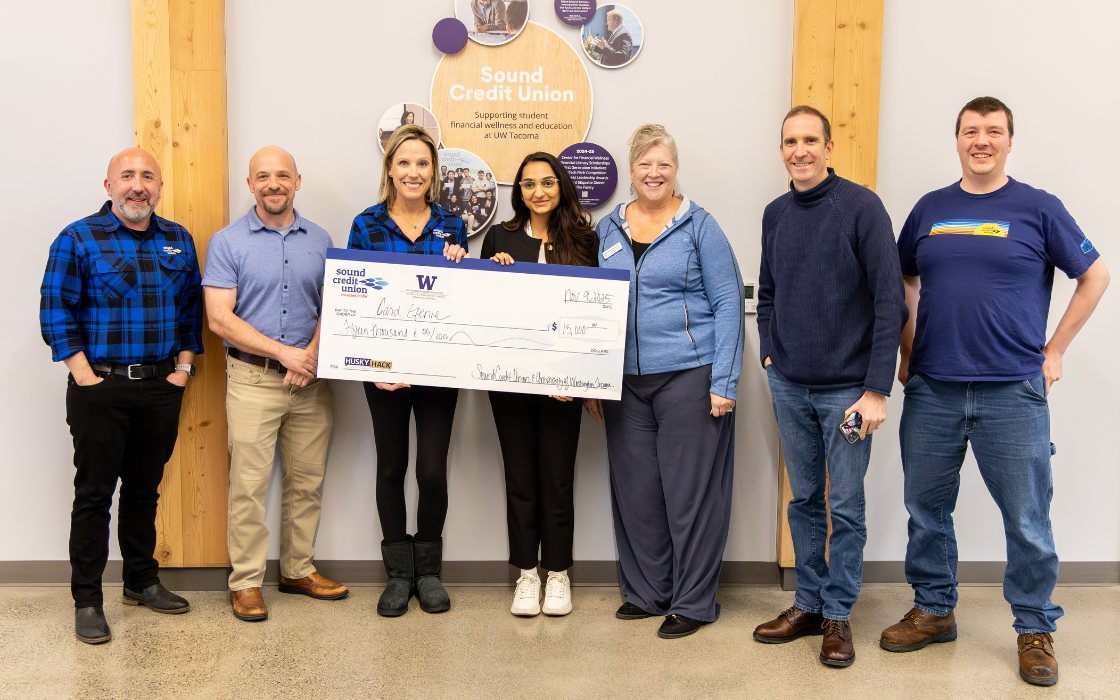
Ultimately, the HuskyHack grand prize was awarded to Riddhi Bajaj — a UW Tacoma graduate student pursuing a Master of Science of Business Analytics at the Milgard School — for her work on CardGenie, a solo project built to help users better manage credit cards and rewards with the help of AI. CardGenie allows users to view rewards across cards in one place, receive reminders about unused perks and discover opportunities based on spending patterns or upcoming life events, thanks to AI-powered insights.
Bajaj described the experience as a rapid but rewarding sprint that required balancing problem analysis with technical execution.
“HuskyHack was an incredible 24-hour sprint that pushed me to turn an idea into reality,” said Bajaj. “What made it special wasn't just building CardGenie, but designing a solution for a problem that impacts millions of Americans who unknowingly leave money on the table.”
Judges highlighted the clarity of Bajaj’s solution and its strong connection to the hackathon’s challenge statement.
“Competing solo was challenging, but it taught me that with the right tools and mindset, you can accomplish far more than you think possible,” Bajaj reflected. “I'm grateful to Sound Credit Union and UW Tacoma for creating a space where students can tackle real-world financial challenges, and to the judges for their invaluable feedback throughout.”
The Milgard School of Business at UW Tacoma cultivates business leaders through cutting edge and personally accessible education, diverse scholarly exploration and innovative community engagement while promoting social responsibility.
The Milgard Center for Business Analytics is a catalyst for research, education and innovation. It advances the use of "analytics," "big data" and "smart machines" for actionable insights and business decision-making, working directly with corporate partners to identify, frame and study critical issues and opportunities in business.
Recent news
Main Content

UW Tacoma rises to highest position ever in Military Times ‘Best for Vets’ college rankings
Main Content
IIGE Welcomes Record Enrollment; Students Explore North Star
Main Content
At home on campus
UW Tacoma in the News
Main Content
Criminal justice professor offers AP News insight on the recent decline in deadly acts of mass violence
Main Content
Graduate student and Puyallup tribal member Andrea Bob reflects on regalia, being first-generation
Main Content
UW Tacoma art professor honors community through dumpling art
Contact Information
- Phone: 253-692-5630
- Email: mcba@uw.edu
- Center for Business Analytics (directory)