
Take a walk through the University of Washington Tacoma’s campus, and you'll notice more than just students, faculty and staff moving between classrooms and offices.
Because UW Tacoma is seamlessly woven into Tacoma’s historic downtown district, neighbors meet for coffee at one of the nearby cafes after a stroll on the Prairie Line Trail. They drop by one of the many restaurants along Pacific Avenue for a quick bite to eat while students shop the small local businesses that dot the T-Line.
With shopping, museums and the city's convention center just around the corner, it's easy to see why so many visitors unexpectedly find themselves on campus.
How the community interacts with the university prompted the campus master planning team to think more deeply about the role it plays within the downtown corridor, says Leon Rost, a partner at Bjarke Ingels Group (BIG) who worked on the plan’s development.
“We're used to looking at the plan and all the campus maps with Pacific (Avenue) on the bottom, and kind of looking at it uphill. But to the community, they're looking at it the other way,” Rost said. “It's almost like turning the globe upside down and putting the southern hemisphere on the top.”
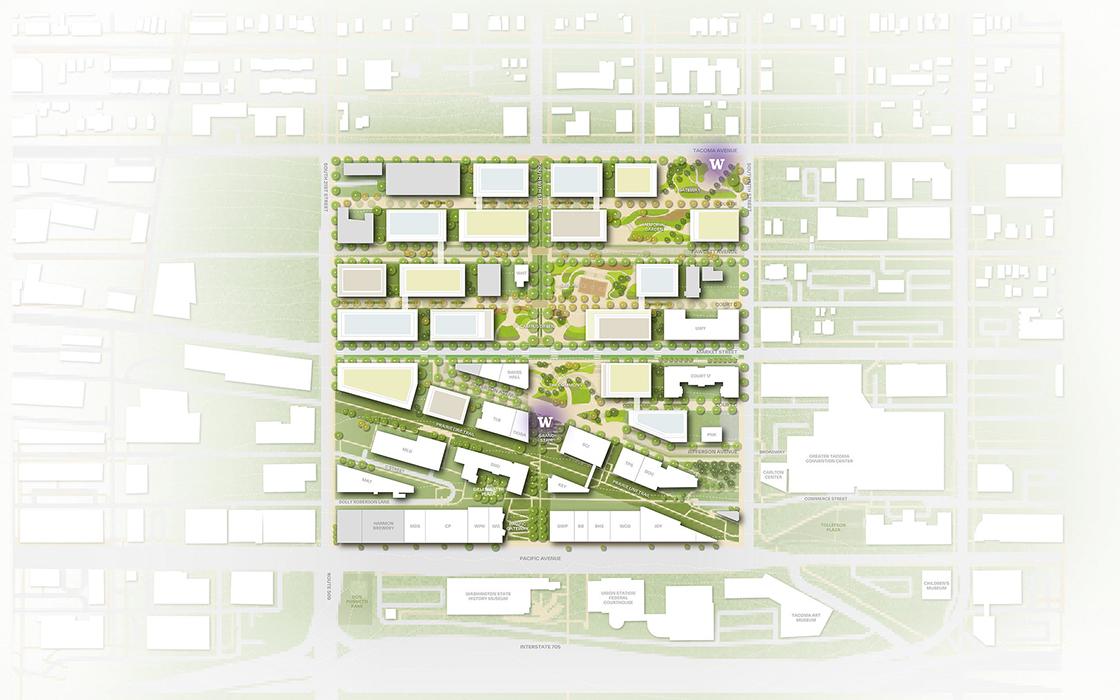
That treasured community connection inspired the team to envision UW Tacoma not just as a growing college campus, but as downtown Tacoma's largest park.
Collaborations with groups like Parks Tacoma explored how the university can utilize its land to improve local access to outdoor spaces. As a result, the plan features small parks, pedestrian areas and new greenery designed to encourage students, staff and visitors to experience the campus in unique ways.
The master plan calls for adding hundreds of new trees across campus — a significant step for a city with the lowest tree coverage in Western Washington.
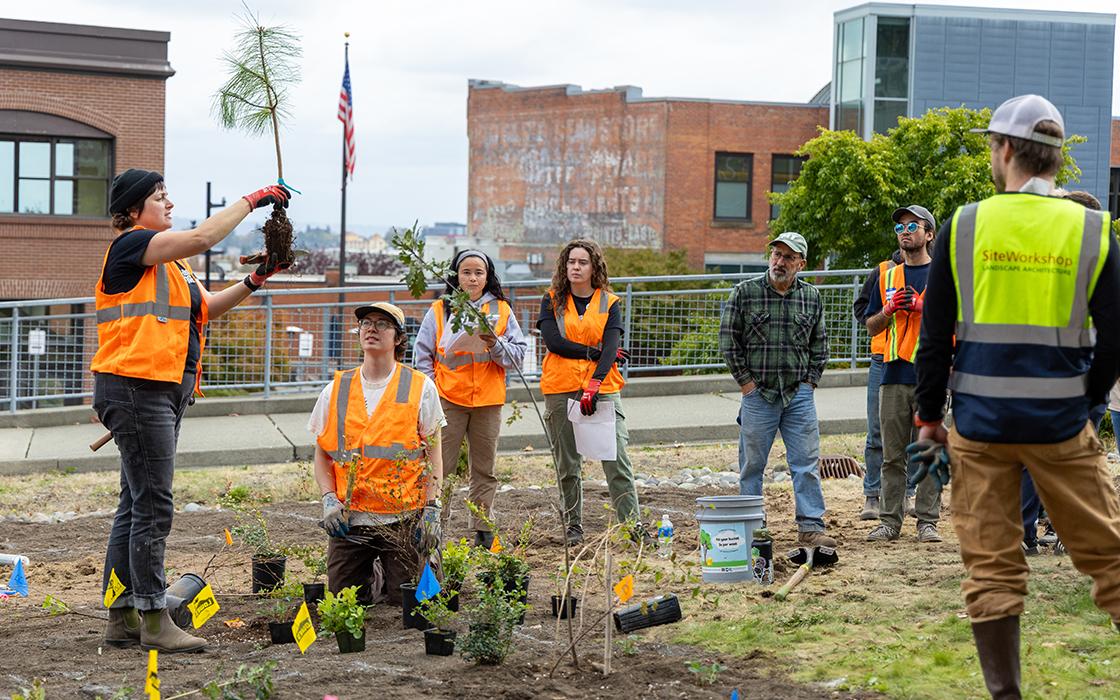
Work toward this goal is already underway. Last fall, students, faculty and staff volunteers planted nearly 200 native trees, shrubs and ferns to create a microforest on campus. With guidance from local nonprofit Tacoma Tree Foundation, the group came together during UW Tacoma’s 2025 Fall Day of Caring to plant the new vegetation.
“We see it as a direct intervention in the issues that arise when urban landscapes lack a robust tree canopy — such as the heat island effect and poor air quality,” says Rubén Casas, Ph.D., an associate professor in the School of Interdisciplinary Arts and Sciences who serves as a faculty lead for the project. “Because these effects tend to impact parts of cities that are already burdened by many types of inequity, this project is a response to long-standing environmental injustice in our region.”
Visit UW Tacoma’s Instagram to watch a video about the new microforest project.
As the campus becomes a more connected and cohesive place, the university is also looking for ways to use its downtown footprint to create spaces that welcome the community in.
In addition to expanding green spaces, UW Tacoma will keep working with the Puyallup Tribe of Indians to create artworks that honor Tacoma’s past and look ahead to its future.
Several new art installations are proposed in the campus master plan, including native plantings, a longhouse and story poles that help pay homage to Coast Salish history and traditions.
Bill Sterud, Chairman of the Puyallup Tribe, helped break ground on the campus 35 years ago and says it feels like it was just yesterday that he attended the university’s official ribbon-cutting ceremony in 1997.
“We are deeply proud of our long-standing connection to UW Tacoma and grateful for the university’s continued work to honor the ancestral homelands of the Puyallup people,” Sterud said. “Our Tribe has collaborated with the university on several meaningful projects throughout the years to promote cultural awareness and education within the South Sound community. We look forward to continuing this partnership and to co-creating even more installations that pay tribute to the land on which we live.”
Each element included in the master plan was purposefully added to make the campus a place people want to be — spaces that spark connection, invite exploration and make every visit feel meaningful and worthwhile.
“We want people at a very young age to come to campus and know this is a place for you," said Sylvia James, UW Tacoma’s Vice Chancellor for Finance & Administration. "From that early age, we are telling them that they belong on our campus. They see the Rainier Vista, the academic buildings and the idea that the revitalization of campus is for our community. I think that is really representative of who UW Tacoma is, and who we serve."
This story is part three of a five-part series on the development of UW Tacoma’s new Campus Master Plan. Keep reading to explore how students and faculty turned the campus master plan's development into a real-world learning opportunity.