Developed in partnership with campus and community leaders, UW Tacoma’s new master plan charts a course for meeting the South Sound’s evolving needs.
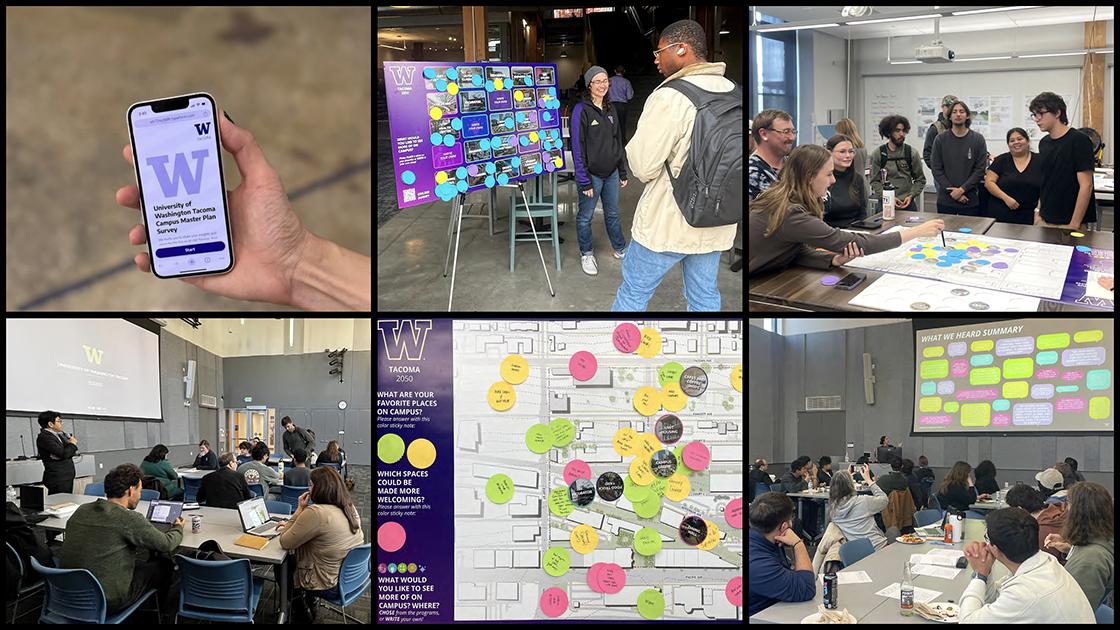
The development of UW Tacoma's campus master plan involved a multi-stage community-driven planning process with a variety of stakeholders.
More than 200 pages in length, UW Tacoma’s new campus master plan is the result of a yearlong process that brought together voices from across campus and the community.
Through engagement sessions, campus tours, surveys and small group conversations, the planning team gathered input from a wide range of perspectives.
“We saw this as a living piece of work that integrates our strategic plan, and we really wanted to engage people differently,” said Sylvia James, UW Tacoma’s Vice Chancellor for Finance & Administration.
Hundreds of people shared their insights and ideas throughout the process. Faculty and staff, university leaders, neighboring businesses, the Puyallup Tribe of Indians, city officials and UW Tacoma students all played a part in shaping the plan.
Some of the top-of-mind topics for students included affordable dining options, on-campus housing, gathering spaces and parking. With many students at UW Tacoma commuting from across the South Sound, these needs came up frequently in conversations.
Leon Rost, a partner at Bjarke Ingels Group (BIG) who worked on the plan’s development, remembers a day early in the discovery process when the firm’s design team visited a class and saw the results of a midterm exercise in which students were tasked with putting their ideas for the campus master plan on paper.
“It was really interesting to take all that in," he said. "Some of those students were also part of the engagement sessions where we invited them to draw on the map…A lot of what we did is aggregate the ideas and try to output something that is coherent and embeds as many of these ideas as we can.”
A community-driven collaboration
A major partner in the plan’s development was the City of Tacoma, which is focused on bringing new investment and opportunities to the downtown area, says Tanja Carter, the city’s community and economic development director.
Carter says UW Tacoma is a vital economic anchor for the city and that the projects included in the master plan will boost daily foot traffic downtown while expanding access to living-wage careers, supporting local entrepreneurship and drawing in new employers.
“A strong pipeline of graduates who remain in the area after completing their degrees is a significant advantage when attracting new businesses to the region,” Carter said. “Additionally, the university’s focus on housing, mixed-use development and green spaces helps us build a vibrant urban core where residents can easily live, learn and work.”
“A strong pipeline of graduates who remain in the area after completing their degrees is a significant advantage when attracting new businesses to the region. Additionally, the university’s focus on housing, mixed-use development and green spaces helps us build a vibrant urban core where residents can easily live, learn and work.” — Tanja Carter, City of Tacoma
Rubén Casas, Ph.D., an associate professor in the School of Interdisciplinary Arts and Sciences who has been involved in the City of Tacoma’s transportation planning efforts, said significant progress has been made over the last two years to lay the foundation for anticipated growth.
According to the Puget Sound Regional Council, Central Puget Sound is expected to grow by 1.5 million people by 2050. Pierce County is expected to receive approximately a fifth (21.7%) of that growth.
“This plan, I think, really dovetails with a list of things that the city has been doing to not only receive that growth, but to also ensure that we can create, maintain and sustain vitality and health for people that work and live in Tacoma,” Casas said.
The path UW Tacoma will chart under the master plan builds upon the reputation it’s already solidified as a significant contributor to the South Sound’s economy and talent pipeline — and local and state leaders have taken notice.
“As the population and economy of the South Sound continues to grow, UW Tacoma serves a critical role in furthering the region’s higher education and workforce development needs,” said Washington House Speaker Laurie Jinkins, who represents Tacoma’s 27th Legislative District. “The legislature recognized the numerous benefits of expanding UW Tacoma’s footprint in the heart of the city with a substantial investment from the state’s capital construction budget, and seeing the long-term vision for the campus starting to take shape is both gratifying and exciting.”
This story is part two of a five-part series on the development of UW Tacoma’s new Campus Master Plan. Keep reading to explore how new green spaces and public art installations will transform the campus into the largest park space in downtown Tacoma.