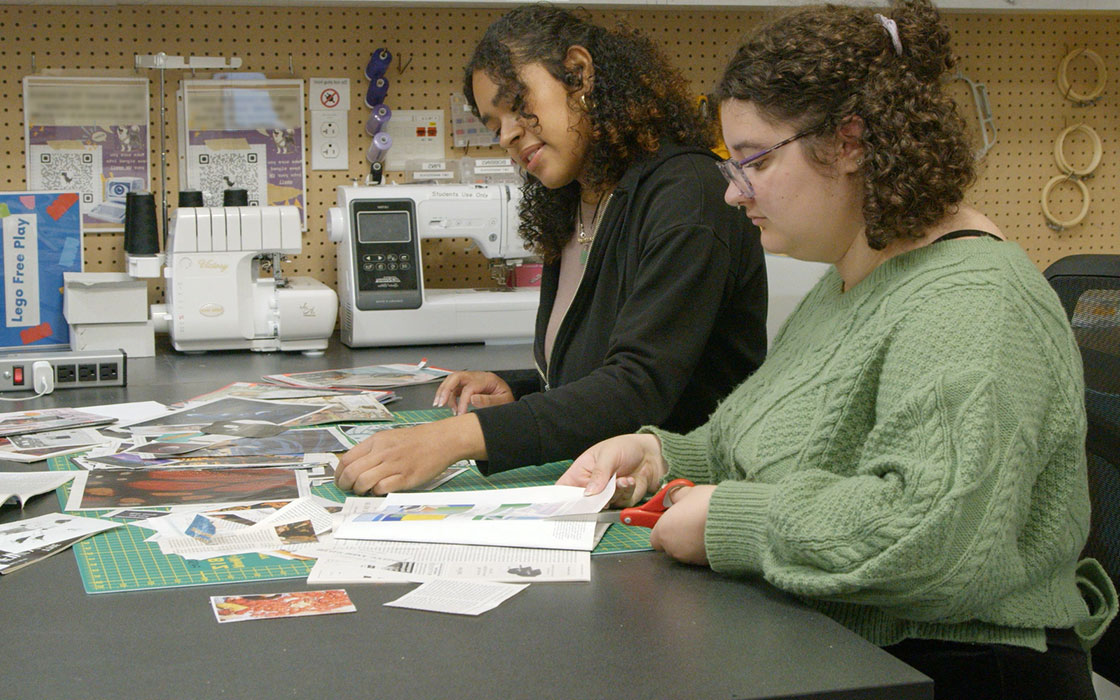
The Makerspace on campus is more than just tools. It's a place where people get to discover others — and themselves — through common interests.
Did you know there is a place on campus where any students can use a 3D printer, learn to sew, lasercut vinyl decals, paint a figurine or borrow a wide variety of tools?
The Makerspace in the UW Tacoma Library is open to students, faculty and staff in every school, regardless of major. It offers free access to equipment and materials and an opportunity to learn something new or practice your skills.
In addition to signing up to use the equipment, the Makerspace also organizes regular events where people can work together and learn from each other. The goal is to create accessible paths for everyone to use the space. Students can work on projects as part of their school work or just to make something personal. There is no cost to use the tools, but students may need to provide some of their own materials.
D'Andre Williams, who helps manage the Makerspace, loves the community that develops there. "One of the coolest things about the Makerspace is the relationships I've seen come out of this space between students who work cooperatively together just through having similar hobbies and interests."
A new partnership with Highline College is attracting early interest. Graduates of the Bachelor of Applied Science in Early Childhood Education (ECE) and Elementary Education (EE) degrees can now apply to the Master of Education for Practicing Educators (MEd) program at UW Tacoma.
UW Tacoma’s ACCESS in STEM program has received a $2 million National Science Foundation grant to support the retention and graduation of high-achieving students from communities with limited financial resources who are pursuing degrees in STEM fields.
With his new book, “Improvising With and In Higher Education: All Together Now,” UW Tacoma Associate Teaching Professor Luke Perone invites readers to rediscover play as a practice for collective learning and development.
Hui Suk So, Assistant Teaching Professor and Director of the Financial Literacy Initiative at the Milgard School Center for Financial Wellness, appeared on Good Day Seattle to discuss how Tacoma Huskies are gaining money management skills alongside their degrees.
With the rise of car-centric city planning over the past century, Tacoma aims to become a community where cars aren't required for residents to access basic needs. Associate Professor Rubén Casas is quoted.
Chancellor Sheila Edwards Lange joined KBTC’s public‑affairs program to talk about the university’s plans for new student housing and dining facilities.