


Main Content
Introduction
In the 1800s and early 1900s, America was expanding quickly. Cities were growing upward and outward. Railroads stretched across the continent, and rivers that once blocked travel needed permanent crossings. Engineers had bold ideas for longer and lighter bridges, but those ideas depended on one critical factor. The materials had to be strong enough to make these new bridges possible. That is where the Roebling Steel Company changed the future of bridge building.
Founded in 1849 by John A. Roebling, the company focused on a simple challenge: traditional materials such as stone, timber, and cast iron handled compression well, but they were unreliable when stretched. Suspension bridges rely on tension. Their massive cables carry weight by being pulled tight across long distances. If those cables failed, the whole bridge would fail.
Roebling introduced high-strength steel wire manufactured with exceptional precision and consistency. For the first time, engineers could design ambitious suspension bridges knowing that the material would behave exactly as expected. By the early 20th century, Roebling steel wire rope had become the trusted standard for major suspension bridges, elevators, mining systems, and industrial lifting operations across the United States.
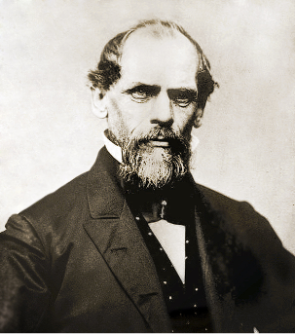
John Augustus Roebling (born Johann August Röbling; June 12, 1806 – July 22, 1869)
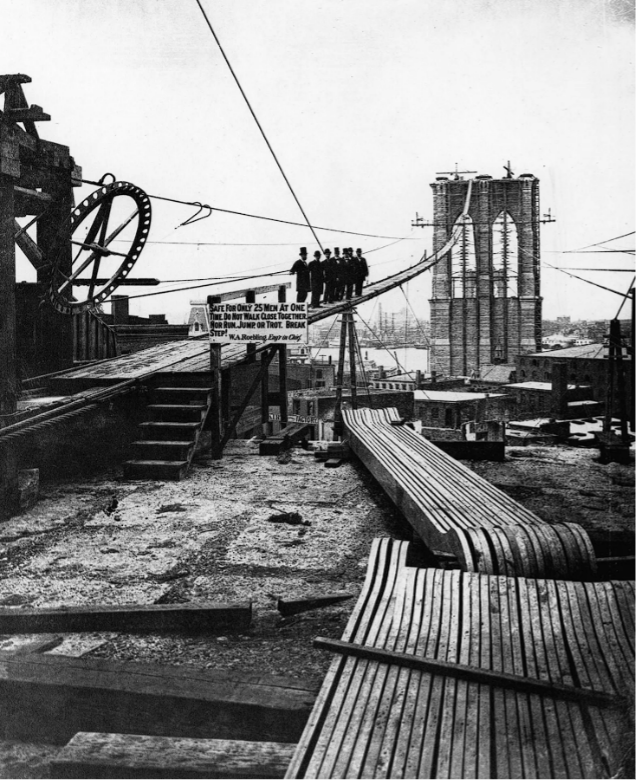
Brooklyn Bridge Construction, c. 1878
Engineering Strength Through Manufacturing
Roebling’s success was not accidental. It came from control and discipline inside the factory. Instead of relying on outside suppliers, the company handled every step of production. Steel was refined, drawn into wire, twisted into strands, and assembled into massive cables under direct supervision. This complete oversight ensured quality at every stage.
The wire drawing process strengthened the steel by reshaping its internal grain structure. Each wire was inspected for uniform diameter and predictable performance. That level of consistency mattered. Suspension bridge cables remain under constant tension for decades. Engineers needed to trust that every strand would share the load exactly as designed. Since Roebling controlled the entire process, engineers could calculate forces with confidence and expect real-world performance to match their designs.
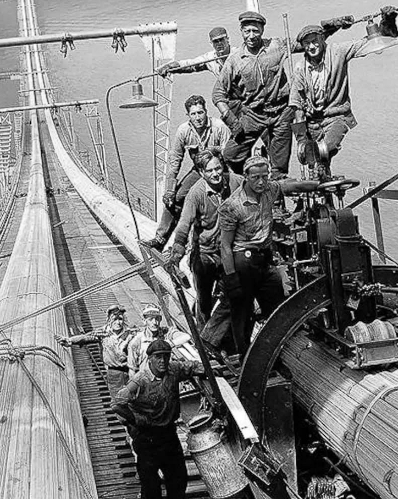
John Augustus Roebling (born Johann August Röbling; June 12, 1806 – July 22, 1869)
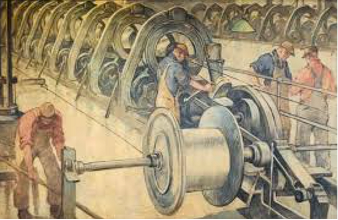
Roebling Factory. Trenton, NJ. 1927
Landmark Projects and National Impact
Long before the Tacoma Narrows Bridge was built, Roebling steel had already proven itself on some of the most iconic bridges in American history. It was used in the Brooklyn Bridge, the Niagara Falls Suspension Bridge, and many other long-span crossings around the country. Each project strengthened the company’s reputation. The material performed reliably, year after year, under heavy traffic and harsh weather.
By the 1930s, specifying Roebling wire for major suspension bridges was common practice. It was not chosen because it was experimental or flashy. It was chosen because it worked.
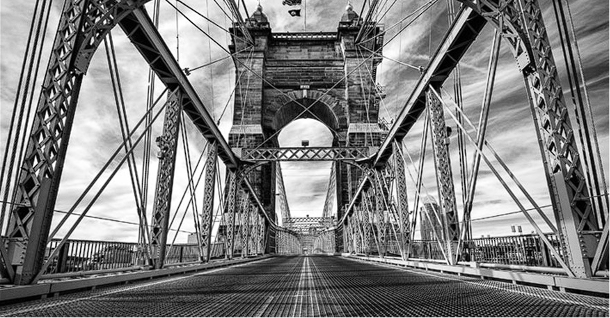
John A. Roebling Suspension Bridge. Covington, KY
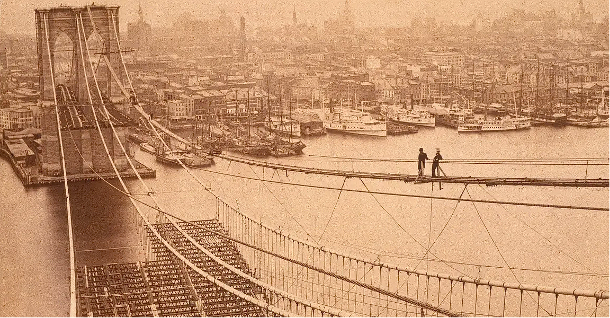
Brooklyn Bridge Construction. Brooklyn, NY
Roebling and the Tacoma Narrows Bridge
When plans for the Tacoma Narrows Bridge moved forward in the 1930s, the project required steel that could be trusted to carry enormous loads across a long and slender span. At that time, Roebling already had decades of proven experience supplying high-quality wire for major suspension bridges throughout the country. Because of this established reputation for strength, consistency, and reliability, the decision was made to use Roebling steel wire for the original Tacoma Narrows Bridge.
The bridge relied on Roebling steel wire for its primary suspension system. This included the massive main cables that supported the roadway and the vertical hanger cables that transferred the weight of the deck and traffic into those main cables.
These components carried the full weight of the structure across the Narrows. When the bridge collapsed in 1940, the suspension cables did not snap or rupture. The steel performed as designed. The failure was caused by aerodynamic instability of the bridge deck, not by a breakdown of the material itself.
This distinction is important. Even though the bridge is remembered for its dramatic collapse, the Roebling cables fulfilled their engineering role. The lesson learned was about aerodynamics and not about the quality of the steel.
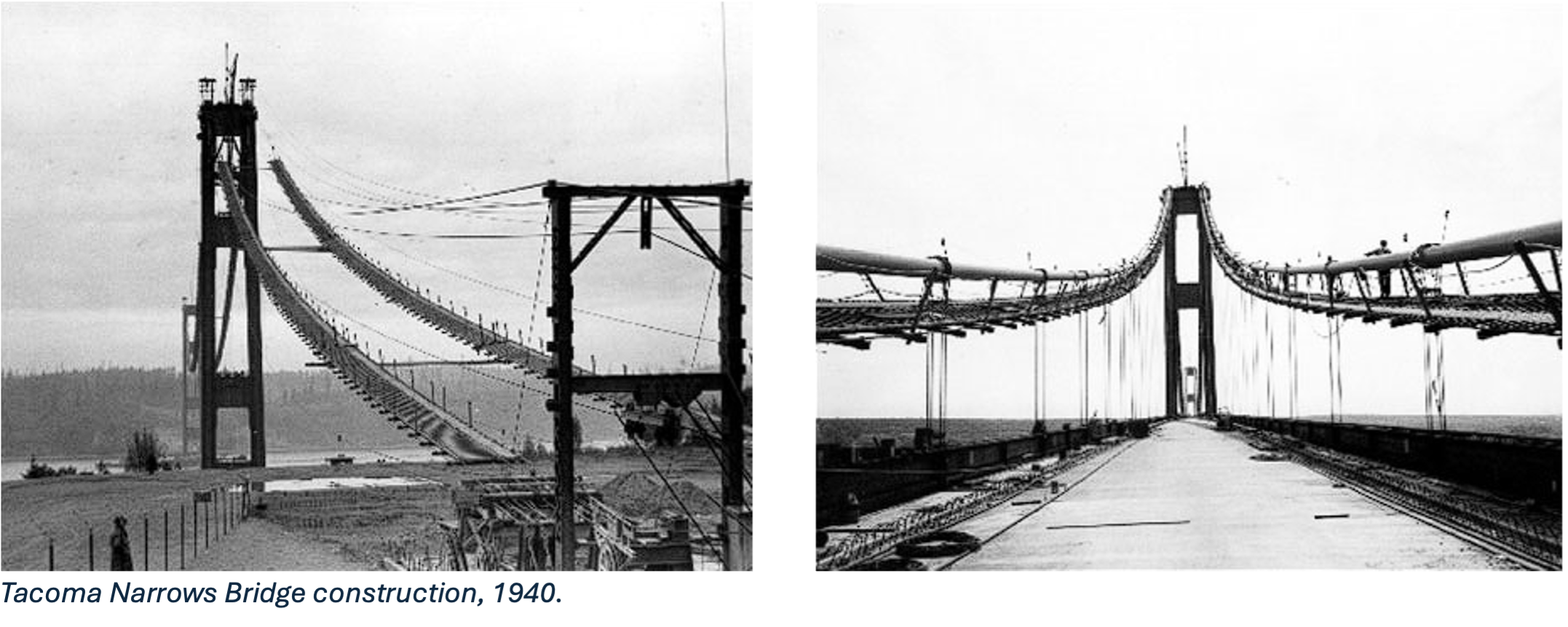
Tacoma Narrows Bridge construction in 1940
References
Roebling Company History & Manufacturing Practices
Smithsonian National Museum of American History
John A. Roebling’s Sons Company Records
Primary archival source documenting the founding of the company, its wire-rope manufacturing practices, and its role in American infrastructure.
Roebling Museum (Roebling, New Jersey)
History of John A. Roebling’s Sons Company
Provides historical background on the company’s vertical integration, wire-drawing techniques, and industrial significance.
Roebling Engineering Philosophy & Major Projects
Encyclopedia Britannica
John A. Roebling
Authoritative overview of Roebling’s engineering career, suspension bridge work, and development of steel wire rope.
Encyclopedia Britannica
Brooklyn Bridge
Confirms Roebling wire rope use, cable construction methods, and the broader engineering impact of Roebling’s suspension bridge work.
Tacoma Narrows Bridge Context & Cable Performance
Washington State Department of Transportation (WSDOT)
Tacoma Narrows Bridge History
Confirms that the 1940 failure was caused by aerodynamic instability and not tensile failure of the suspension cables.