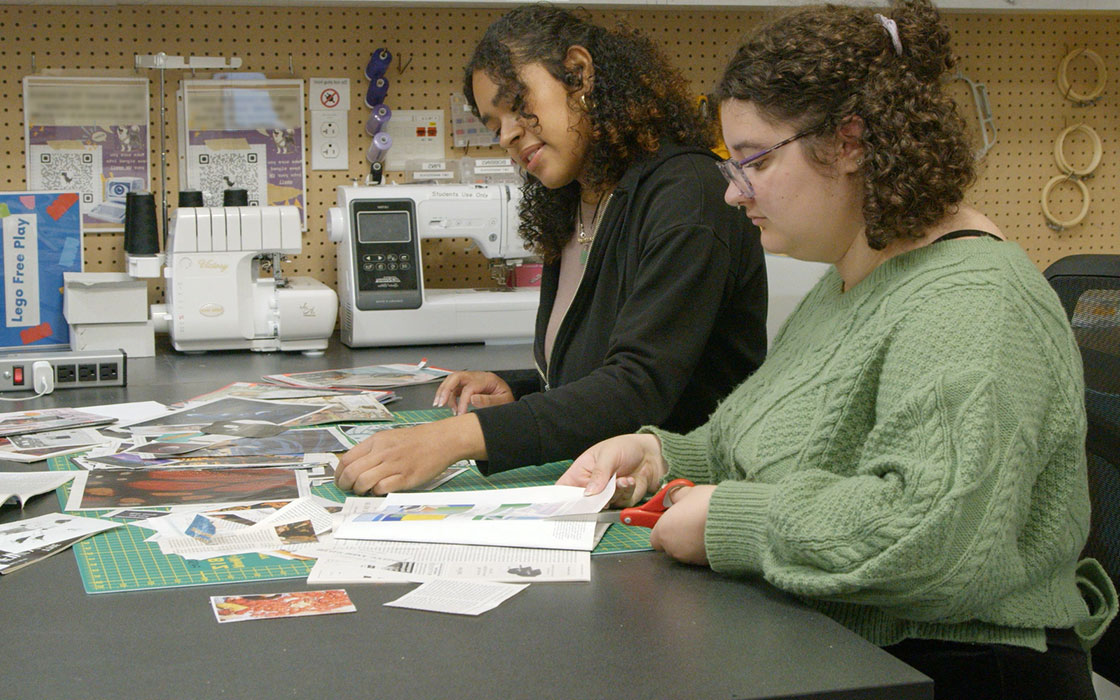
The Makerspace on campus is more than just tools. It's a place where people get to discover others — and themselves — through common interests.
Did you know there is a place on campus where any students can use a 3D printer, learn to sew, lasercut vinyl decals, paint a figurine or borrow a wide variety of tools?
The Makerspace in the UW Tacoma Library is open to students, faculty and staff in every school, regardless of major. It offers free access to equipment and materials and an opportunity to learn something new or practice your skills.
In addition to signing up to use the equipment, the Makerspace also organizes regular events where people can work together and learn from each other. The goal is to create accessible paths for everyone to use the space. Students can work on projects as part of their school work or just to make something personal. There is no cost to use the tools, but students may need to provide some of their own materials.
D'Andre Williams, who helps manage the Makerspace, loves the community that develops there. "One of the coolest things about the Makerspace is the relationships I've seen come out of this space between students who work cooperatively together just through having similar hobbies and interests."
As a student, Diana Algomeda (BA '19, M.Ed. '22) emerged as a compassionate and effective leader on campus. Today, as the latest recipient of UW Tacoma’s Distinguished Alumni Award, she continues to champion equitable access to education through her career.
At UW Tacoma, undergraduate students have ample opportunities to engage in research that tackles complex questions and creates tangible community solutions.
As the founder of Columbia Bank and an influential advocate for higher education in Tacoma, Bill Philip played a key role in the creation of UW Tacoma. Chancellor Sheila Edwards Lange reflects on his legacy in a Puget Sound Business Journal article about his passing.
The dating app Bumble, whose trademark feature required women to initiate connections with potential love matches, has seemingly changed course. Associate Professor Riki Thompson argues that this reversal — allowing men to send the first message — is Bumble's attempt to stay relevant in a crowded market and an ever-changing dating scene.
Marine Ecologist and Assistant Professor Eliza Heery joined This Green Earth to discuss urban marine environments, the creatures that inhabit them and how we can be better stewards of our waters.