Social work grad snags Survivor second runner-up
Like tallying the votes without torchlight, no season of Survivor is complete without an oddball on the beach: the eccentric personality who can play to a quirky soundtrack as easily as they can drop an epic one-liner mid-blindside.
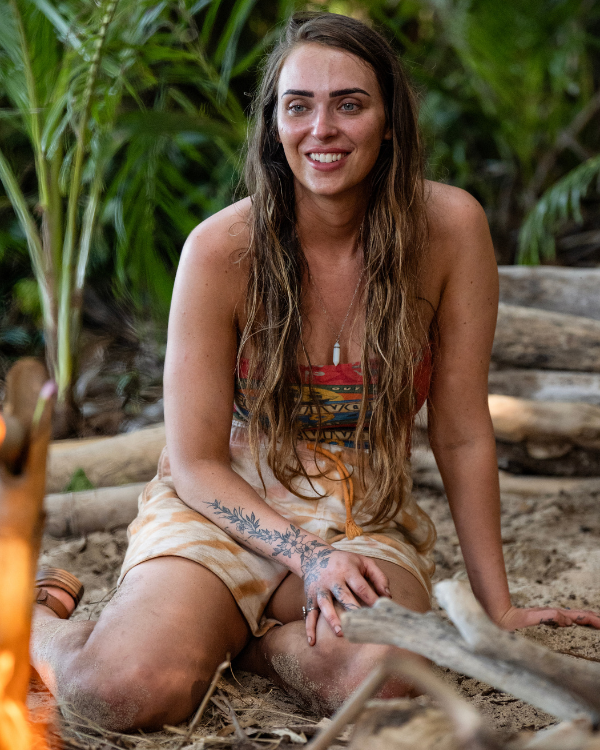
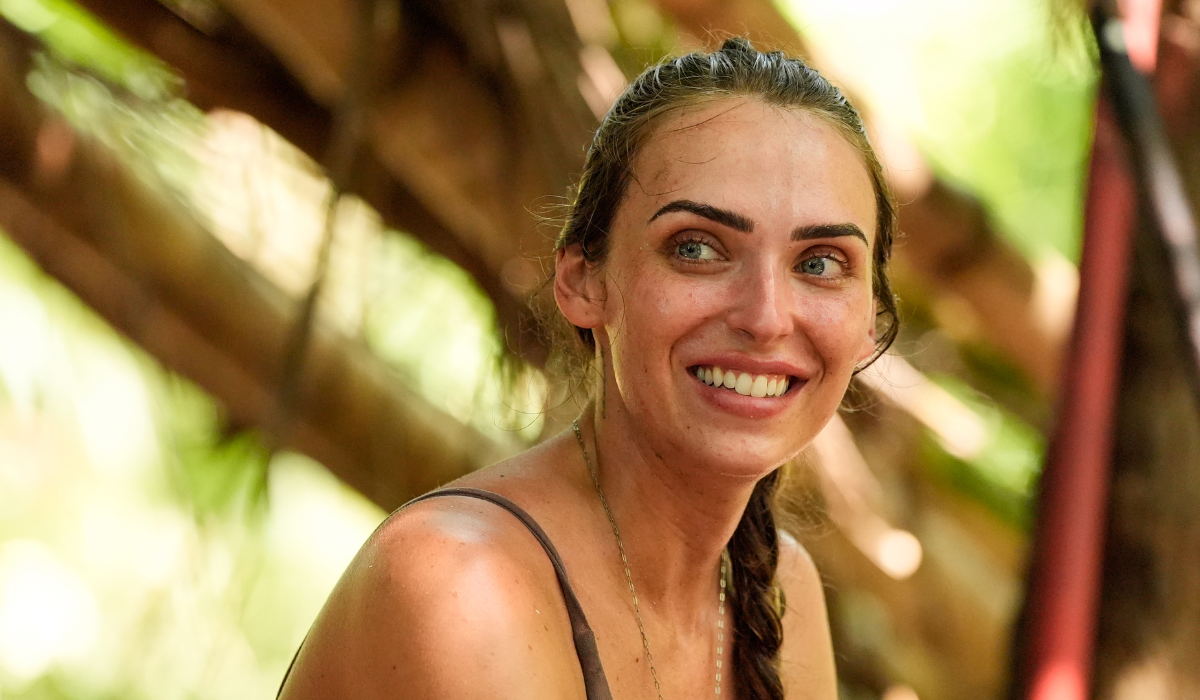
Within this varied subcategory of TV trope, Sage Ahrens-Nichols (MSW, ‘24) sits firmly in the “goofy” camp — right where she wants to be.
It was nearly a year ago that season 49 of Survivor debuted, and the world was introduced to Ahrens-Nichols: a Master of Social Work graduate who honed her Survivor strategy at UW Tacoma long before she landed in Fiji.
Between an unfiltered approach to relationship-building and her affinity for bodily functions, Ahrens-Nichols won over the world and honored her personal journey with every on-camera confessional. “This story is one of finding my way back to that weird little kid who didn’t fit in anywhere,” Ahrens-Nichols explained. “But finding my way back to her and loving her this time.”
Survivors Ready?
Before millions of weekly viewers, Ahrens-Nichols navigated one of television's most demanding, long-running social experiments:
She and 17 other players were marooned for nearly a month on Fiji’s Mamanuca Islands.
With extremely limited resources, players competed in challenges, forged alliances and eliminated threats at Tribal Council — the show’s formal elimination ceremony that culminates each episode with a vote — assembling a jury of previous players week by week.
That jury would eventually cast their ballots to award the million-dollar prize to one of three finalists.
And Ahrens-Nichols was one of them.
She made it 26 days in the game without safety in the vote, leaving her vulnerable to elimination week after week. Even so, Sage had only one vote cast against her all season, proving her capacity to build trust, navigate shifting alliances and consistently position herself as someone others wanted to keep around. For the few people who play Survivor, a game built around voting people out, it’s an impressive feat — but even fewer make it to Final Tribal Council.
There, Ahrens-Nichols made her case to the jury for a million dollars, admitting her wackiness was a smokescreen while she played both sides — all while revealing her decade-long military career to the other players for the very first time.
Iconic as her big reveal was, it’s also a testament to Ahrens-Nichols’s social savvy; As it turns out, the skills she relied on most were cultivated years earlier at UW Tacoma, where studying social work transformed how she understood herself and others.
Ultimately, Sage finished the game in third place behind first runner-up Sophi Balerdi and winner Savanah Louie, who was crowned Sole Survivor of season 49.
Iconic as her big reveal was, it’s also a testament to Ahrens-Nichols’s social savvy; As it turns out, the skills she relied on most were cultivated years earlier at UW Tacoma, where studying social work transformed how she understood herself and others.
Ultimately, Sage finished the game in third place behind first runner-up Sophi Balerdi and winner Savanah Louie, who was crowned Sole Survivor of season 49.
The Search for Direction
As someone who identifies as insatiably curious, Ahrens-Nichols’ path to Survivor was hardly linear (not that she was ever the type to follow a predetermined plan).
For starters, she’s a twin.
Ahrens-Nichols left the traditional path to her brother.
“When we graduated high school, my twin brother headed straight to an expensive, private university, but I didn’t want to take out loans,” Ahrens-Nichols explains. “I remember thinking, ‘If I went to college right now, I’d blow it, but I don’t want to stay in this small town, either,’” she admits, reflecting on her Southern upbringing in the sticks of North Carolina. “‘I’ve seen people get stuck here.’”
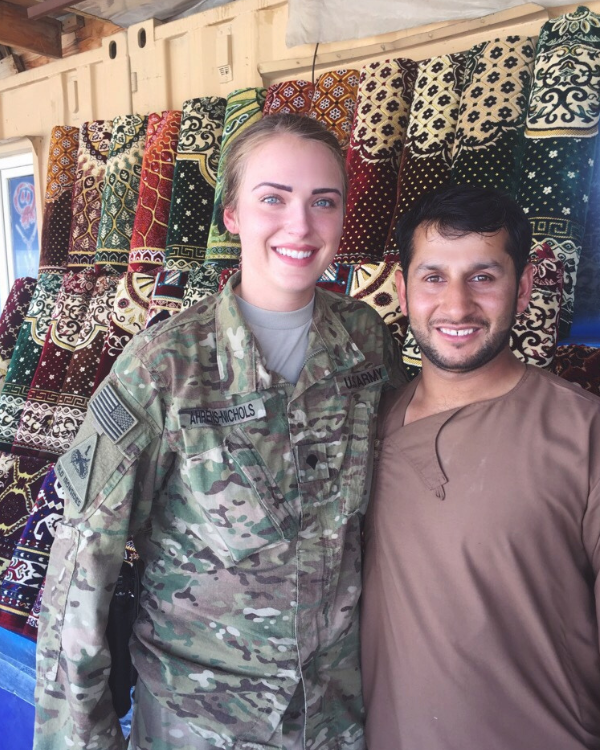
Opting instead to join the military straight out of high school, Ahrens-Nichols enlisted in the U.S. Army at 18 so she might someday graduate from college debt-free.
Sage enlisted in a combat-arms military occupational specialty (MOS) before being deployed to Afghanistan. There, she fell down the reality TV rabbit hole, one Big Brother marathon at a time. After returning home from overseas deployment, Ahrens-Nichols reclassified to intelligence operations — one of three distinct career paths she would explore as an active-duty soldier.
During her decade of military service, Ahrens-Nichols developed physical and mental resilience, but ultimately felt drawn to something different. “It finally clicked one day in my mid-20s: I could do whatever I want. I want to do whatever I want,” Ahrens-Nichols says. “I want to experience life. I want to try things.”
And she has.
On Survivor, Ahrens-Nichols told her teammates about the time she played the Easter Bunny at the mall one spring — a gig she accepted to gain professional mascot experience (required if you ever hope to be cast as a minor-league baseball character).
As far as career retrospectives go, however, Ahrens-Nichols’s time at UW Tacoma was perhaps the ultimate resume builder.
Easter Bunny to Tacoma Husky
Ahrens-Nichols was fascinated by social dynamics long before she came to campus. “I was in fifth grade when I knew I wanted to be a therapist,” she explains. “I was very intrigued by human behavior.”
By the tail end of her military career, she was working in a behavioral health unit, where she was first exposed to the many different specialties that make up social work.
“Before that, I was under the impression that social workers were in child welfare,” Ahrens-Nichols says, reflecting on her previous misconception. “I had no idea it was such a vast career field… Learning about what social work actually was, I was like, ‘This is the path I’m destined to take.’”
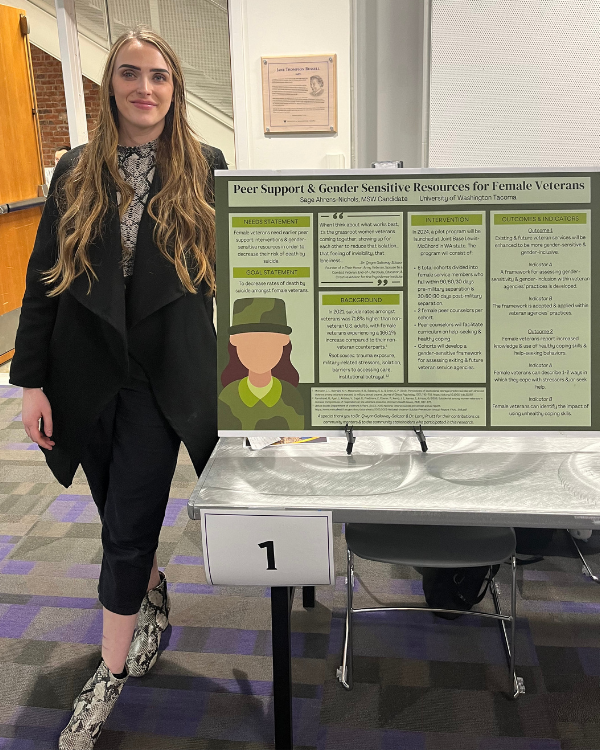
As a graduate student on campus, Ahrens-Nichols continually put herself out there, staying open to every opportunity that was hers for the taking, whether through UW Tacoma’s “life-changing” Master of Social Work program or her side hustle as poetry editor of the campus literary and arts magazine, Tahoma West.
“At the time, it just seemed like a cool opportunity, something I did on a whim,” Sage says of the editorial-driven extracurricular. “But now I see it as an early example of my primary guiding principle: If it sounds cool, just go for it! It started at Tahoma West, and somehow, it led to Survivor.”
Behind the Curtain
Whether she picked a program or answered a calling, Ahrens-Nichols enrolled in UW Tacoma’s School of Social Work & Criminal Justice in 2021, not realizing just how much her world was about to change.
"I couldn't truly understand people because I was only trying to understand them through the context of myself, and not through the context of their own experiences,” she reflects. “When you can't look past the curtain of your own privilege, I don't think you’ll ever actually get the full human experience… The social work program at UW Tacoma tore that curtain right off.”
One of the most transformative elements of Ahrens-Nichols’s time at UW Tacoma was the mentorship she received from faculty members who challenged her academically and recognized her potential.
She credits social work professor Anindita Bhattacharya as a key figure in her trajectory, bringing her awareness to intersectionality and all the blind spots (and moments of connection) that come with it.
“If you don’t understand something, it’s not because the thing doesn’t inherently make sense — it just doesn’t make sense to you because you haven’t had those experiences,” Ahrens-Nichols describes. “We live in a binary world, and learning about intersectionality helped me see that everything’s a spectrum.”
After reading one of her papers, Dr. Bhattacharya encouraged Ahrens-Nichols to pursue further postgraduate work, noting that her work reflected doctorate-level thinking. “I just felt so seen and understood in a time when I was still learning how to see and understand myself.”
That brief interaction reignited a long-held academic dream for Ahrens-Nichols, while reinforcing what so many Tacoma Huskies come to know for certain: Sometimes, the most influential educators go beyond teaching to help students recognize their own potential, even when they haven’t realized it yet.
Among the major takeaways of grad school, Ahrens-Nichols learned to de-center her perspective with every person she met and every story she heard. This paradigm shift was generative, especially in terms of grace: more grace for herself and for others, and for the lived experiences that make each of us truly singular.
“If I had played Survivor 10 years ago, before studying social work, it would’ve been an entirely different outcome; I would’ve taken everything as a personal attack,” she says. “Finally, it was like, ‘Wait — not everything’s about me.’ And for that reason, I don’t need to take things personally.”