


Main Content

Objective
From: ME Summer Research Project - 2025 by Brandon Mason and Dr. Mark Pagano
This project began with a surviving section of steel cable from the original Tacoma Narrows Bridge. The smaller vertical suspender cables connecting the main suspension cables to the bridge deck carried a portion of the bridge’s weight throughout its service life. While the collapse in 1940 has long been understood as an aerodynamic failure, this investigation focused on the material itself.
The purpose of this work was to determine the mechanical properties and chemical composition of the original cable steel. Tensile tests were performed on two individual wire strands that were removed from the cable. In addition, chemical composition analyses were conducted by two independent laboratories to confirm the steel grade and compare it with known specifications for high-carbon wire products used during the time of the original construction.
Tensile Testing
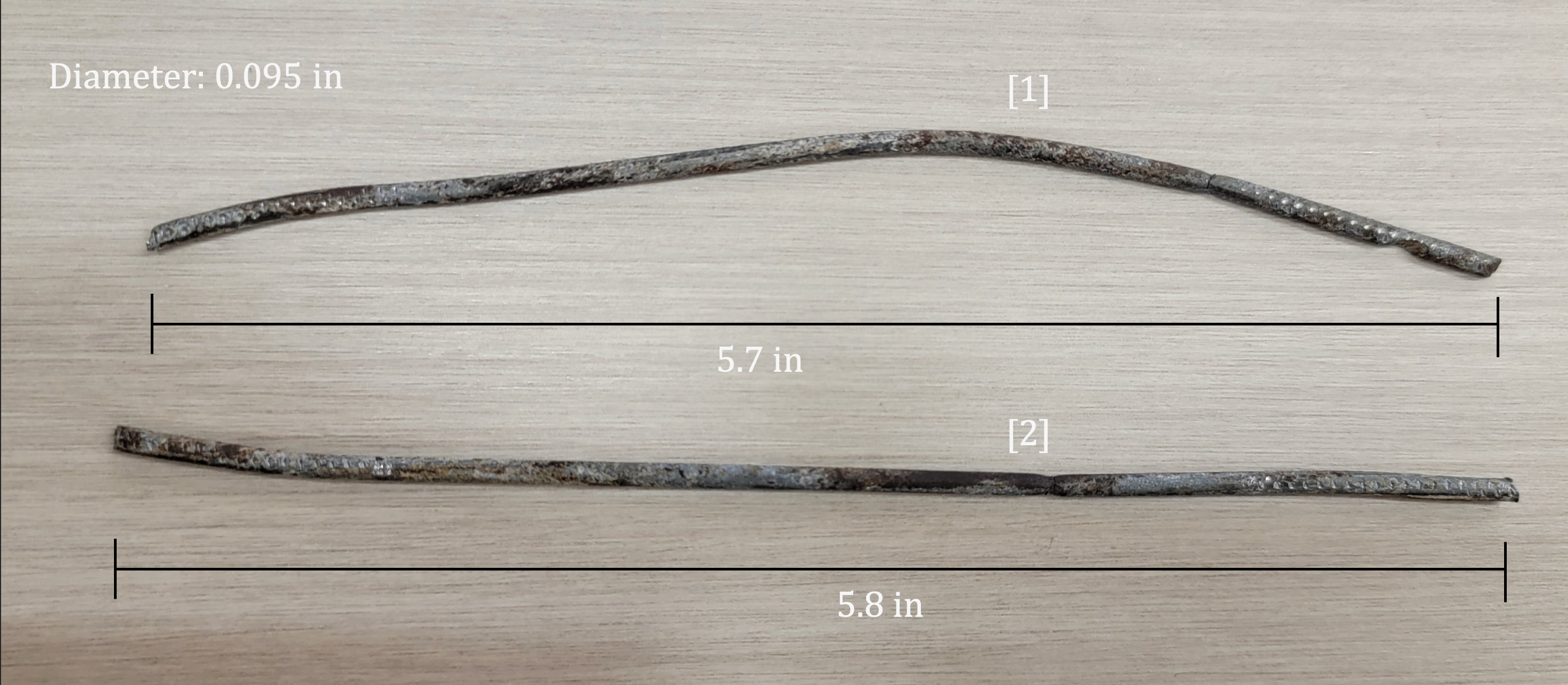
Figure 1: Cable samples from each test in their corresponding test order with their respective original lengths and diameters.
Individual wire strands were cut from the larger cable bundle and prepared for testing. Figure 1 shows the two specimens in their original test order along with their measured diameters and original lengths prior to loading.
Figure 2 shows one of the original cable samples mounted in the universal tensile testing machine during loading. Each specimen was pulled in tension until fracture, while applied force and displacement were recorded continuously.
From this data, stress-strain curves were generated for the tests. Since the wires were not standard machined specimens, strain was calculated using crosshead displacement rather than an attached extensometer. This method introduces limitations for strain-based measurements, such as modulus of elasticity and fracture strain. However, strength values derived directly from load and cross-sectional area remain fully valid.
Since ultimate tensile strength is based purely on load over cross-sectional area, this measurement remains valid because it does not rely on displacement. Yield strength measured by the 0.2% offset method is approximate, and modulus of elasticity values are also approximate due to the use of crosshead displacement rather than extensometer readings. The apparent modulus values are lower than the accepted ~29 Msi for carbon steel due to machine compliance inherent in crosshead displacement measurements. The modulus values reported in Table 1 were obtained by fitting a straight line to the linear portion of each stress versus strain curve using MATLAB.
Potential grip slippage was also considered during analysis because strain was calculated using crosshead displacement rather than a directly attached extensometer. Significant slippage would typically appear as discontinuities, abnormal curvature, or excessive strain accumulation in the initial elastic region of the stress-strain curves. However, both tests showed smooth and consistent behavior with similar elastic response between runs, suggesting that major clamp slippage was not present during testing.
In the graph, there is a small J-shaped region that appears at the beginning of the stress–strain curves before the response becomes more linear. This portion of the curve is caused by the cable straightening out and removing the slack before the full tensile load is carried by the wire. This was due to the initial "twisted" shape of the cable specimen prior to being placed in the grips. Once the cable was fully tensioned, the curve transitioned into a more representative response of the material's behavior under load.
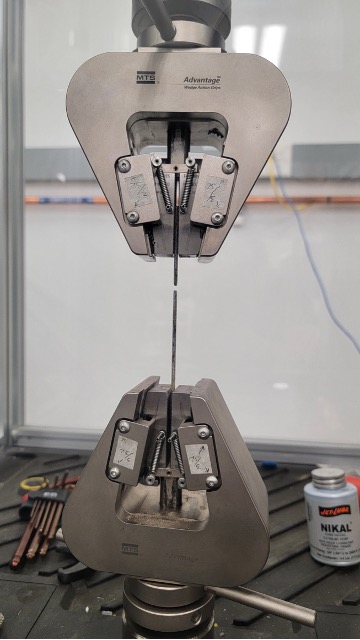
FIGURE 2: Suspension cable sample mounted in the universal tensile testing machine grips during testing.
| Run 1 (d=0.095in) |
Run 2 (d=0.095in) |
Validity | |
|---|---|---|---|
| Modulus of Elasticity (Msi) | 16.0 | 16.3 | APPROX. (crosshead method) |
| Yield Strength (ksi) | 126.3 | 121.6 | APPROX. |
| Ultimate Tensile Strength (ksi) | 252.4 | 248.4 | VALID |
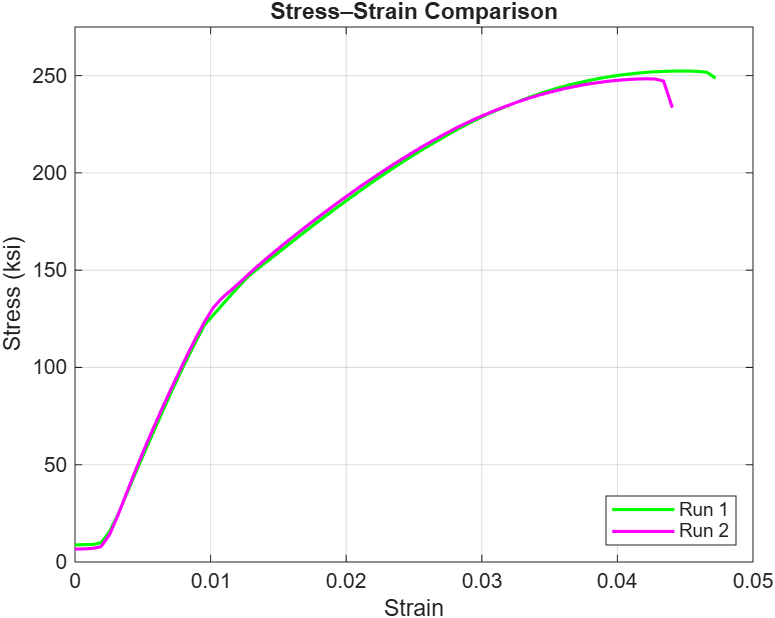
Figure 3: Stress-Strain comparison of tested samples
Testing Hardness
The hardness tests produced values of 101.2, 104.9, and 104.3 HRB. These results do indicate a relatively higher level of hardness, but are invalid because the Rockwell B scale is not appropriate for high-carbon steels. The HRB scale uses a 1/16th inch steel ball and lighter load that can deform and provide misleading results for harder steels.
The appropriate method would have been the Rockwell C scale with a diamond cone indenter and heavier load, which is not available in the UW Tacoma materials lab. For this reason, the recorded hardness values are invalid and were not included in any published documentation.
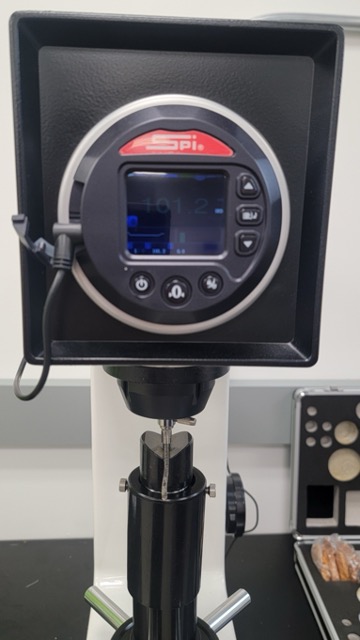
FIGURE 4: Digital display of the Rockwell hardness tester showing one of the recorded values.
Chemical Composition
The chemical composition results from two independent laboratories both confirmed the cable steel as a high-carbon plain carbon steel in the AISI 1074/1075 range. The first lab identified it as AISI 1074, while the second reported AISI 1075. Despite the slight variation in designation, the measured carbon, manganese, phosphorus, and sulfur contents were nearly identical, and all fell well within the expected specification limits. This consistency reinforces that the suspension cable was produced from appropriate high-strength steel.
The measured ultimate tensile strengths were on the higher end of what is typical for steels in this grade. This suggests that the cable wires likely underwent post-processing such as cold drawing or work hardening, which are both common practices in wire manufacturing to increase strength beyond what composition alone would predict.
| Element | Atrona Lab | IMR Lab | Specification |
|---|---|---|---|
| C | 0.76 | 0.73 | 0.70 - 0.80 |
| Mn | 0.58 | 0.58 | 0.40 - 0.80 |
| P | 0.018 | 0.014 | 0.030 Max |
| S | 0.023 | 0.031 | 0.050 Max |
| Si | 0.19 | 0.24 | — |
| Ni | 0.03 | 0.04 | — |
| Cr | 0.06 | 0.05 | — |
| Mo | 0.007 | <0.01 | — |
| Al | — | <0.01 | — |
| Cu | 0.08 | 0.08 | — |
| Fe | — | Balance | Balance |
| Conforms to/ Acceptability |
UNS G10750 (AISI 1074) |
UNS G10750 (AISI 1075) |
Discussion
The combined mechanical and chemical testing of the bridge cable provides a more complete picture of the material’s role in collapse. The cable steel showed high strength and performance well above the levels needed for ordinary structural steels. The tensile tests supported this and showed consistent ultimate tensile strengths across both runs and confirmed that the cable was not a weak link in the bridge’s design.
Although the modulus of elasticity could not be validated without an extensometer, the strength metrics that could be trusted were more than sufficient to show that the material exceeded basic design requirements.
Taking all of this into consideration, these findings emphasize that the bridge’s collapse was a problem of design and aerodynamics rather than metallurgy. In a sense, this deepens the tragedy that the cables themselves were engineered with remarkable quality for the time, yet the bridge as a system failed. This can be seen as an important lesson for engineers today. Even when materials and individual components meet or exceed their specifications, structural performance ultimately depends on how all elements interact under real operating conditions.