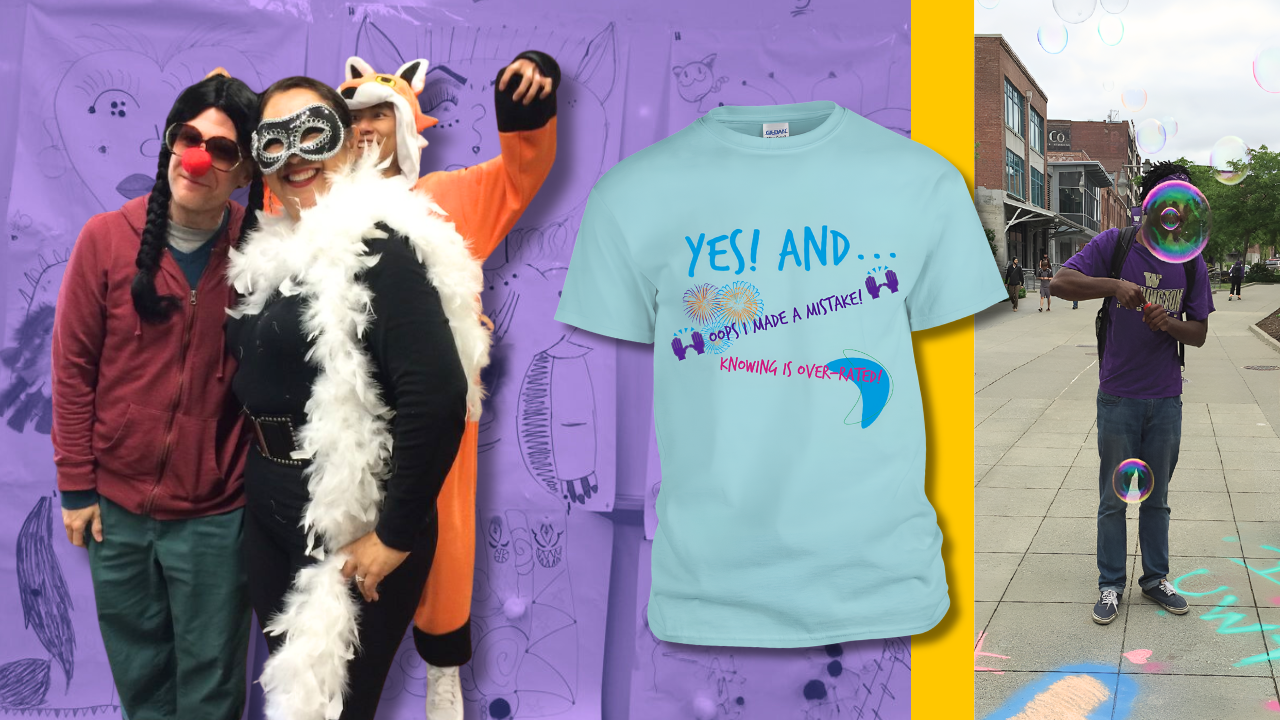
Improvisation and making the case for play in serious places
What if play — not as escape, not as entertainment, but as a practice — is one of the most powerful ways adults learn, connect and build something meaningful together?
It’s a deceptively simple question that Luke Perone, Associate Teaching Professor of Social Sciences, has explored for more than three decades.
His newly released book, “Improvising With and In Higher Education: All Together Now,” offers a response that is deeply scholarly and refreshingly human. Drawing on play in the form of improvisational theater, human development and lived experience across classrooms and communities, “All Together Now” makes the case for improv as a radical strategy for co-creation that invites students, faculty, staff and community members to build higher education together.
Radical Co-Creation
Higher education has a reputation for products and structures: course syllabi, outcomes, assessments, meetings about meetings. Play, if it appears at all, tends to feel like a warm-up act before we roll up our sleeves to take on the “real” work (or like an after-party once that work is done).
But what if we have the story wrong?
“From a learning, development, community-building and community change perspective, play is a lifelong activity,” Perone says. “It’s an inspiration to create and re-create the world as we would like it to be.”
“All Together Now” brings together administrators, faculty, staff, students and community partners from across higher education who experiment with improvisational approaches to transform academic life. Intentionally designed as a long-form improvisational performance, the book’s ideas emerge, build upon and respond to one another across chapters, rather than marching toward a single authoritative conclusion.
While improvisational practices apply readily to teaching and learning, “All Together Now” widens the lens, exploring what happens when they’re applied across the full ecosystem of higher education, in administration, faculty development, research, community engagement and leadership. Rather than treating classrooms and lecture halls as isolated sites of learning, the book invites entire institutions to operate with greater responsiveness, relationality and shared authorship.
And as it turns out, breaking free of institutional ways of thinking, learning and educating that no longer serve us may be as simple as saying, “Yes, and…”
On Keeping the Scene Alive
At the heart of Perone’s work is improvisational theater (“improv”). Improvisers proceed entirely without a plan, relying on support from one another to keep the performance alive. The fundamental throughline of improv — consistently responding with, “Yes, and…” — fosters this atmosphere of acknowledgement and co-creation.
“The ‘Yes, and…’ approach of improv is a small but mighty practice,” Perone says. “It says, ‘I see you. I hear what you’re giving. And I want to create with it.’ This approach invites students, educators and community partners, in very revolutionary ways, to be co-creators of their environments.”
The implications of this practice for adult learning and institutional life are profound, Perone argues.
“We tend to think of play as something children do. But adults are constantly improvising,” he writes. In many environments, however, including those of higher education, adult improvisation is often hidden, constrained and even discouraged. By contrast, improv asks us to stay eternally open — to confidently move forward without knowing exactly where things will land. In doing so, Perone asserts, it offers higher education a path away from transactional and fixed models of learning and development, and toward something more relational and generative.
From Getting Something to Making Something
This emphasis on co-creation challenges some of higher education’s most familiar scripts. Instead of asking, “What do I need to get out of this class, degree or institution?” improv invites a different orientation: “What can we make together?” And that shift — from consumption to collective contribution — has ripple effects.
In Lifespan Imaginative Play, a course Perone has been teaching at UWT for more than a decade, his pupils see this dynamic play out firsthand. Rather than summing up key arguments or responding to questions from the day’s assigned reading, Perone’s students are invited to develop a “playful learning experience” for the class that’s inspired by the text.
What does such an experience look like?
Think less PowerPoint presentation, and more “powerful performance of play.” Some pairs of students re-create improv games within scholarly texts. Others coordinate flash mobs, collaborative art pieces or reimagined board games to help lessons stick.
Regardless of what Perone’s students eventually offer for their playful learning experience, one thing is true for all of them at first: they worry about “getting it wrong.” But the structure of the experience reframes those fears as material — fodder for the creative process — rather than obstacles. Open-ended by design, assignments like these are nerve-wracking. Still, Perone’s students count them among their most meaningful academic experiences, noting the ways in which facilitating play forces them to remain open to outcomes they might never have predicted for themselves.
As the quarter continues, these playful learning experiences move beyond the classroom as students are invited to co-create in their communities. Over time, students report connecting more deeply not only to the course material, but to one another — learning, as one evaluation put it, “both academically … and through practice.” It is, as Perone and his ensemble of creative collaborators describe in “All Together Now,” a perspective shift that extends far beyond a single course.
Why it Matters Here
In a moment when colleges and universities find themselves under pressure to assert their value, Perone’s new book offers a quiet proposition that’s timely and profound.
The university experience doesn’t just prepare students for specific jobs — it develops adaptability and collaboration as skills that make new possibilities imaginable. In this sense, play nurtures well-roundedness, a critical strength for institutions whose future may depend less on having fixed answers and more on our willingness to keep the shared scene alive, by learning and developing together.
What “All Together Now” ultimately offers is not a prescription for better teaching, but a different way of imagining higher education itself. Improvisation, if you put it to Perone, shouldn’t be confined to classrooms or learning, but embraced as an innovative way to build relationships, conduct research, engage communities and navigate uncertainty.
Improv introduces new possibilities in a sector often defined by established structures, predictability and individual expertise. And the result? Shared authorship — and, in place of ease or certainty, more room for magic.
_____
Luke Perone is an associate teaching professor in social sciences at UW Tacoma, where his teaching, research and community-building explore how play, improvisation and performance shape learning and development across the lifespan. His work extends well beyond the classroom, through international collaborations with educators, therapists, artists and community organizers committed to building more humane and connected ways of learning and developing together. “Improvising With and In Higher Education: All Together Now” is published by Palgrave Macmillan and available now through major booksellers.