


Main Content
INFORMATION
PROGRAM OVERVIEW
DEGREE OPTIONS
ADMISSION REQUIREMENTS
HOW TO DECLARE YOUR MAJOR
CURRICULUM
INTERNSHIPS
GRADUATION REQUIREMENTS
Want more information? Click here to book an appointment with the Academic Advisor.


Program Overview
The School of Urban Studies at UW Tacoma offers a BA in Sustainable Urban Development. Beginning in spring 2026, we are excited to announce the introduction of revised degree requirements and options designed to better prepare our students to answer the challenges facing our cities today and into the future.
As one of the first such degrees in the nation, students will be prepared to address recent initiatives that have called for a significant “greening” of urban development, both locally and internationally. Graduates will be prepared for careers in planning agencies, corporations adhering to sustainability practices, consulting firms, nonprofit organizations, and environmental/resource related agencies at the local, state, and federal levels of government. The degree is also excellent training for further graduate study in fields such as urban planning, public administration, and law.
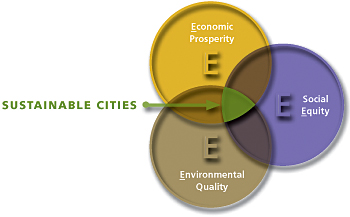
The 3 E's of sustainable development
The interlocking goals of sustainable development: environmental quality, economic prosperity and social equality. Sustainable cities live at the nexus of these goals.
Did you know?
- We are a majority urban society, worldwide
- In 2008 we reached a global milestone: more than half of the world’s population is urban
- Over 80% of the U.S. population already lives in a metropolitan region
- Cities can be the solution, not the problem, when it comes to global sustainability
Accomplishing sustainable urban development is a crucial challenge for the twenty-first century. The University of Washington Tacoma is at the forefront of engaging and educating undergraduate students on this topic. The Sustainable Urban Development degree provides students with a critical and rigorous training in ecological, political, economic, and social aspects of urban development processes.
Sustainability is often treated as a synonym for environmentalism...but that's not the whole story. Sustainability is not just about the environment; it is also about social equity and economic prosperity. The Urban Studies faculty invites you to learn how cities and urban regions are the key to true sustainability — for the planet and for the people who populate it.
Students will learn how to understand, assess, and manage urban development processes through a carefully designed curriculum that includes urban policy, planning, and environmental science coursework. The degree provides students with a broad but concrete understanding of linkages between urban ecosystems, urban systems (planning, transit, energy, etc.), and the multi-dimensional problems of urbanization, especially as they relate to public policy and urban advocacy.
Beginning spring 2026 BA in Sustainable Urban Development students will choose one of two formal options: Community Engagement or Geographic Information Systems (GIS).
Degree Options
Sustainable Urban Development Majors select one of two formal options: Community Engagement or Geographic Information Systems (GIS).
BA Sustainable Urban Development: Community Engagement
Examines the production and development of cities from different community perspectives and teaches how cities are planned and built, and the power dynamics that influence inclusion and exclusion from urban spaces and political processes. Explores new strategies and builds new skills in community engagement for producing better cities and improving urban conditions.
BA Sustainable Urban Development: Geographic Information Systems (GIS)
Prepares students to solve complex social, economic, and environmental problems by combining GIS (geographic information systems) based approaches to mapping and spatial analysis with a classical and theoretically critical foundation in urban studies.
Admission Requirements
If you have completed the prerequisites listed below, you can be considered for admission to the Bachelor of Arts in Sustainable Urban Development.
- Cumulative GPA of 2.0 in all college coursework
- Completion of a minimum of 40 college-level credits
- 5 credits of English composition
- Meet with the School of Urban Studies Academic Advisor to discuss degree requirements and submit a declaration of major form.
The Sustainable Urban Development major admits students every quarter.
How to Declare Your Major
If you are a current UW Tacoma student
Step 1: To declare Sustainable Urban Development as your major, please contact the Academic Advisor to discuss your academic plan.
Step 2: An official request will be submitted on your behalf to the Registrar's Office.
If you are not a current UW Tacoma student
Please visit the UW Tacoma Admissions website to submit the appropriate application or to connect with them.
Transfer students meeting the above requirements may apply directly to the major.
First-year students will need to be admitted to UW Tacoma and complete the above requirements prior to declaring your major.
Curriculum
Major Requirements
Major Requirements
The curriculum consists of 70-71 credits, depending on formal option and course selection:
- Shared Curriculum courses (20 credits)
- Foundation courses (25-26 credits)
- Formal options (choose one option) (25 credits)
In addition to the coursework required for the major, students are required to complete general university requirements and electives, and to bring their total number of credits to 180. Running regular degree audits and asking your advisor for a degree planning worksheet here will help track your progress through the program.
Shared Curriculum Courses (20 credits)
T URB 101 Exploring Cities (5)
T URB 103 Urban Studies in Practice (3)
T URB 110 Urban Data Analysis (5)
T URB 200 Introduction to Urban Research (5)
T URB 403 Professional Development for Urban Careers (2)
Foundation Courses (25 credits, choose 5 courses)
T URB 220 Introduction to Urban Planning (5)
T SUD 222 Introduction to Sustainability (5)
T SUD 240 City & Nature (5)
T GIS 311 Maps & GIS (6)
T URB 314 Gender & the Urban Landscape (5)
T URB 322 Land Use Planning (5)
T URB 410 Environmental Equity (5)
T SUD 444 Green Internationalism and the City (5)
T SUD 445 Urban Ecology (5)
Formal Options
Students must declare one of the following formal options:
| A. Community Engagement | B. GIS Certificate |
|
Complete all of the following: Choose 2 of the following: * Students choosing the Community Engagement formal option cannot apply T URB 220 to their foundation course credits. |
GIS Certificate **: Complete all 5 courses listed below: ** Note: GIS Certificate courses are sequential and cohort-based. Students must apply to the certificate program by posted deadlines and contact the Academic Advisor to discuss course planning. *** Students choosing the GIS formal option cannot apply T GIS 311 to their foundation course credits.
|
General Electives
In addition to the coursework required for the major, students are required to complete general university requirements and electives, and to bring their total number of credits, including the above requirements, to 180.
The balance of credits needed to meet University credit requirements are general electives. Students may focus on an in-depth area of study (i.e., a minor or certificate) or explore the liberal arts, business, social work or health-related fields; or may take further T URB or T SUD courses. Transfer credits from other institutions may apply toward general electives.
Contact the School of Urban Studies Academic Advisor to help track your progress through the program.
Internships
School of Urban Studies majors have the opportunity to complete an internship for academic credit. Visit our Internship Opportunities page for more information.
Tracking your progress
It is the student's responsibility to understand the above degree requirements and to track their own progress using the Degree Audit (DARS) function accessible through their MyPlan. Contact the School of Urban Studies Academic Advisor for help.
Students admitted prior to spring 2026 may complete their current degree requirements, or speak with their academic advisor about changing to the new curriculum.
The curriculum consists of 74 credits of required courses:
- Introductory courses (11 credits)
- Foundation courses (27 credits)
- Methods courses (16 credits)
- Major electives (20 credits)
The degree starts with an introduction into the discipline of urban studies with course topics on exploring cities, world development, and urban studies "in practice." The core courses provide foundational content related to urban sustainability, and major electives allow students to focus on topics that interest them. Graduates will be prepared for careers in planning agencies, corporations adhering to sustainability practices, consulting firms, nonprofit organizations, and environmental/resource related agencies at the local, state, and federal levels of government. The degree is also excellent training for further graduate study in fields such as urban planning, public administration, and law.
Introductory Courses (11 credits)
T URB 101 Exploring Cities (5)T URB 102 City in World Development T URB 110 Urban Data Analysis (5)
T URB 103 Urban Studies in Practice (1)
Foundation courses (27 credits)
T SUD 222 Introduction to Sustainability (5)
T SUD 240 The City and Nature (5)
T SUD 444 Green Internationalism and the City (5)
T SUD 445 Urban Ecology (5)
T SUD 475 Community and Economy (5)
T URB 403 Professional Development for Urban Careers (2)
Methods courses (16 credits)
T GIS 311 Maps and GIS (6 credits)
T URB 225 Statistics for Urban Analysis (5)
T URB 200 Urban Research (5)
Major Electives (20 credits)
Any T SUD or T URB course not among the required courses may be counted as a SUD major elective. A a maximum of 10 credits total of T URB or T SUD independent research or internship credit may be counted toward these 20 credits. In addition, any of the following courses may be counted as a major elective course toward the SUD major:
T UDE 210 Introduction to Urban Design History & Theory
T UDE 260 Introduction to Urban Design (Urban Design Studio I)
TESC 201 The Science of Sustainability
TEST 332 A Natural History of Garbage
T GEOG 101 Introduction to Geography
T GEOG 210 Geographies of Global Change
T GEOG 321 Urban Geography
T GEOG 349 Geography and International Trade
T URB courses and descriptions
T SUD courses and descriptions
General Electives
In addition to the coursework required for the major, students are required to complete general university requirements and electives, and to bring their total number of credits, including the above requirements, to 180.
The balance of credits needed to meet University credit requirements are general electives. Students may focus on an in-depth area of study (i.e., a minor or certificate) or explore the liberal arts, business, social work or health-related fields; or may take further T URB or T SUD courses. Transfer credits from other institutions may apply toward general electives.
Contact the School of Urban Studies Academic Advisor to help track your progress through the program.
Graduation Requirements
In order to graduate, all UW students are expected to meet general university requirements, many of which can be fulfilled with transfer and/or lower-division coursework:
Graduation Requirements:
- Overall GPA: minimum 2.0 cumulative
- Major GPA: minimum 2.0 in each course required for the major
- GIS Certificate classes: Students pursuing the GIS track must pass each GIS course with a 2.5 or better.