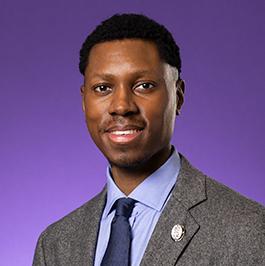
Evan Garner slays the Hedge Fund giants, winning the UWT Investment Challenge with his AI Investment Model.
Evan Garner, a Milgard School of Business finance student, outperforms all other teams in the 2026 Investment Challenge competition by building a tailored AI Investment Model called MAGI. Evan tailored his AI Investment model to a fictional investment client’s priorities for the UW Tacoma 2026 Investment Challenge and still outperformed all other teams, including 2nd place by over 50% in portfolio value.
This required an advanced understanding, using agentic coding tools such as Google Antigravity, Claude code, Codex, and Cursor to piece together a framework for three intersecting models: machine learning, neural networking, and other analytical models that perform between 75-80 billion operations (including sub-processes) to track the inflow and outflow of capital moving through the market. MAGI 2.1 (the AI investment model used for the competition) essentially used an ensemble machine-learning system to treat the equity market as a card game, using probability theory to rank and sort “cards” to determine which equities it wanted to buy or sell. If the model found a card it believed would maintain or gain value, it learned to hold onto the position.
“[You would need] a strong grasp of the fundamentals of Machine Learning, Statistics, Linear Algebra, Computer Engineering, Software Engineering, Data Science, Finance, and the mechanics of financial markets to be able to synthesize those subjects into a working model,” Evan said.
Prior to Evan's work, AI Investment models required a team of engineers and were mostly run by the top hedge funds in the country, according to David Borough-Kim, a Finance Lecturer at the University of Washington Tacoma and Evan’s mentor through the Milgard Distinction of Excellence Program. Evan was able to do this on his own, using AI agentic coding tools and putting together both the technical and finance sides into a model that can compete with the best of Wall Street. The world’s hedge funds have enterprise-level programs that do similar things, but all are proprietary secrets kept close to the chest, not leased out in fear of reverse-engineering.
Built-in Resilience
Evan’s resilience is a tremendous inspiration to others and something the Milgard School of Business regularly finds in its students. Evan learned to face adversity with grit. He faced life battling severe social anxiety and depression, alongside a supportive single mother and a loving uncle, and found his goal of attending college delayed and challenged by catching up on school, family health issues, lay-offs, poverty, and the need to enter the workforce early to help pay bills.
Out of survival and a drive to help his family, he taught himself mathematics to explore Electrical and Mechatronic Engineering, later deciding to pursue a safer route in Accounting at Tacoma Community College to meet UW Tacoma’s prerequisites, and learned that accounting wasn’t for him. It sparked his interest in exploring these skills and led him down the path to the finance program and the Milgard Distinction of Excellence honors program, where he began receiving mentorship from Finance Lecturer David Borough-Kim.
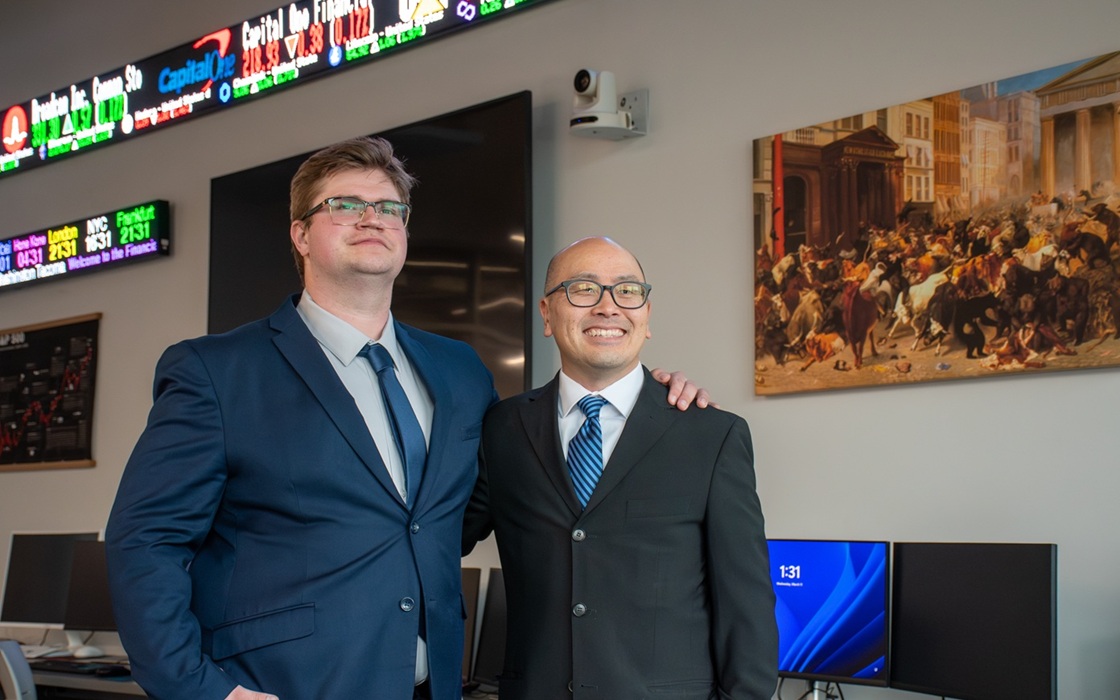
Evan Garner and David Borough-Kim pose with the first-place prize for the UWT Investment Challenge
The Finalists of the UWT Investment Challenge pose after presenting their portfolios.
Evan Garner presents at the UWT Investment Challenge, explaining his AI Investment Model MAGI
March 2025:
After the 2025 Investment Challenge, hearing how students leveraged AI to inform them of stocks to watch, spurred Finance Lecturer Borough-Kim to put together a conceptual white paper, “University of Washington-Tacoma’s AI trading team aims to crack the code for student investors to dominate university stock competitions.” Work began to make progress with another student before they graduated, then work stalled out as summer arrived.
July 2025:
Evan stepped up to the plate and was given a conceptual sketch of what the white paper explored. Three days later, he had the foundation of MAGI’s code running.
August 2025:
They hit the hardware ceiling and connected with Dean Merchant for additional computing power. This began the collaboration with Professor Sergio Davalos from the Center for Business Analytics to optimize and expand the rig. Evan also connected with the Investment Challenge organizer, Professor Ben Chen, to verify that he could use the AI Model in this year’s competition.
“What I really appreciate about Milgard is the student-first approach. If you need something to help a student move forward, the team delivers,” Borough-Kim said.
December 2025:
Fall quarter was a cycle of breaking, fixing, and repeating optimizations of this AI model, but Evan finally watched its breakthrough over Winter break when liquidity scans went green.
January 2026:
By the start of the new year, Evan had transformed raw data into vivid heat maps. Then it was a race of pure trial and error, with long nights and energy drinks, to pump out client-tailored recommendations ahead of the challenge start on January 20th.
You can find more information about the 2026 Investment Challenge here: https://www.tacoma.uw.edu/business/cfw/uwt-investment-challenge
What Comes Next?
With this unprecedented success, Evan holds a proverbial and proprietary golden goose, with a beanstalk of trial-and-error experience to take anywhere. He’s not out of the woods yet, as many challenges remain, including the ongoing computing power problem.
“In practice, [I’m] trying to build a Ferrari engine inside a Honda Civic with my current laptop. At the current state, it sounds like an F-35 taking off when the model is running. The main bottleneck is computing power… [and] having access to more powerful hardware,” Evan said.
When asked what his aspirations and plans were, this is what he had to say,
“I would say working on Wall Street would be my goal or hopefully starting my own hedge fund, but on a philosophical level, my goal is to prove that if you have faith in yourself and have a dream, you can accomplish something special, [or,] as Adele said, ‘Should I give up? Or do I keep chasing pavements?’”
Recent news
Main Content
Co-Creating a Shared Future
Main Content
Tacoma Huskies Take the Stage
Main Content
School of Education Partners with Highline College for Pathway to Master's Degree
UW Tacoma in the News
Main Content
UW Tacoma financial literacy expert talks money management on morning show
Main Content
UW Tacoma professor explores how walkable neighborhoods can help ease the loneliness epidemic
Main Content
UW Tacoma Chancellor discusses student housing expansion, dining project on 'Northwest Now'
Contact Information
- Phone: 253-692-5630
- Email: mcba@uw.edu
- Center for Business Analytics (directory)
- Phone: 253-692-5630
- Email: milgard@uw.edu
- Milgard School of Business (directory)