


Main Content
Tuesday October 27th 2026
For current UW Tacoma Students and Prospective Transfer Students!
Explore your options at UW Tacoma! Meet faculty and advisors, learn about majors and minors, experience a class, and discover programs that match your interests. Choose one- or participate in all three!
Registration is highly encouraged but walk-ins are welcome!
Option 1- Experience a Classroom Visit
Get a firsthand look at what it's like to be a UW student by sitting in on a class:
Time: Varies by course
Below is a list of courses you can register for:
Ready to level up your coding skills? Learn how to design, build, and debug programs using object-oriented programming. You’ll tackle recursion, explore abstract data types, and build your toolkit with essential data structures—all while learning how to make your code smarter, cleaner, and more powerful.
Studio class. We will be designing streets in the region to offer different modes (walking, biking, scooting, taking transit, …) of transportation and to make the streets better for the climate (adding trees, reducing pollution, adding activities,…) to/from campus in the region.
Have you ever wondered how your favorite app knows your order history, how a weather website predicts rain, or how a game knows you just beat the high score? It all comes down to code and by the end of this course, you'll be writing it yourself. No prior experience? Perfect. This class was designed exactly for you. We'll start from scratch and build up to writing real Python programs that can solve problems in science, business, and everyday life. Along the way, you'll learn how to think like a programmer: breaking big problems into small steps, spotting patterns, and building solutions that work. Don't worry! I am not throwing you into the deep end. We'll tackle concepts one at a time, practice them together in the lab, and reinforce them through hands-on problems. By the time final week rolls around, you'll look back at where you started and be genuinely surprised by how far you've come. We will also address the elephant in the room: AI. In addition to programming, we will also learn how to program with AI to increase our AI literacy.
This course examines the role of public engagement in urban planning and development decision making in the United States. Through a collaboration with various public agencies of the City of Tacoma, this class provides an opportunity for students to gain hands-on experience working with local public officials and local residents on development challenges currently facing the city. Students will explore local case studies of presently emerging planning challenges—shared by local public officials and resident activists—and learn how and why members of the local public become involved in shaping decision-making related to those challenges. The central aim will be to build knowledge of the US urban context and build engagement skills that contribute to inclusive urban development and positive social change.
The current federal administration is removing references to "pollution" and decreasing protections for vulnerable populations. It is important for everyone to know what pollution is, where it comes from, how you are exposed to it, and how it affects you and your family and community. In this course we will analyze pollution sources, human exposure, and ways to address the problem. This course is very “hands on” and will include lab work and data analysis.
What makes a crime a hate crime, and who gets to decide? Where does free speech end and a criminal act begin? Why is it so hard to know how often hate crimes really happen?
In this course, students dig into questions that don't have easy answers. We look at why people commit hate crimes, how these crimes affect whole communities, and how hate groups recruit, organize, and operate today, including online. Some of that history happened right here: in 1885, Tacoma forcibly expelled its entire Chinese community.
Students read research, historical documents, and journalism side by side, and learn to weigh evidence and spot a weak source, skills that matter well beyond this class. We also look at what works: how laws, communities, and individuals push back, and how people leave hate movements.
This course provides an introduction to the field of “law and society,” also known as sociolegal studies. This diverse and wide-ranging field is built on a basic shared premise: law and society shape and influence one another. Using an interdisciplinary social science perspective, we will explore how law is lived in people’s everyday lives. How does law shape our social reality? How do people experience, think about, interact with, use, resist, and transform law?
We will explore the various ways culture and identity shape one's relationship with the natural world. In addition to encountering literary expressions of human relationships with the natural world, we will also turn inward and reflect on our own place in this conversation. Our discussions will consider many factors that shape these perspectives. The assigned anthology of nature writing will serve as our entry point to broader discussions of environmental concerns. The selected assigned readings will create opportunities to interrogate the term "nature writing" and help us to work toward a broader understanding of how humans engage with the more-than-human world.
In this course, we will explore the role of space, place, and environment in U.S. literature. Narratives don't develop in a vacuum--they expand across time and space, whether real or imagined. This course takes as its core assumption that these places matter, that they perform a specific and unique function in the text. The literature will serve as the foundation of the course, but it will also open up opportunities to explore and develop our own relationships to specific places.
Networking is the basis of all IT and fundamental to an understanding of cybersecurity. Why did the IP packet cross the network?
Learn about applying economics to understanding and evaluating current policy issues.
Option 2- Explore Your Options at the Majors and Minors Fair
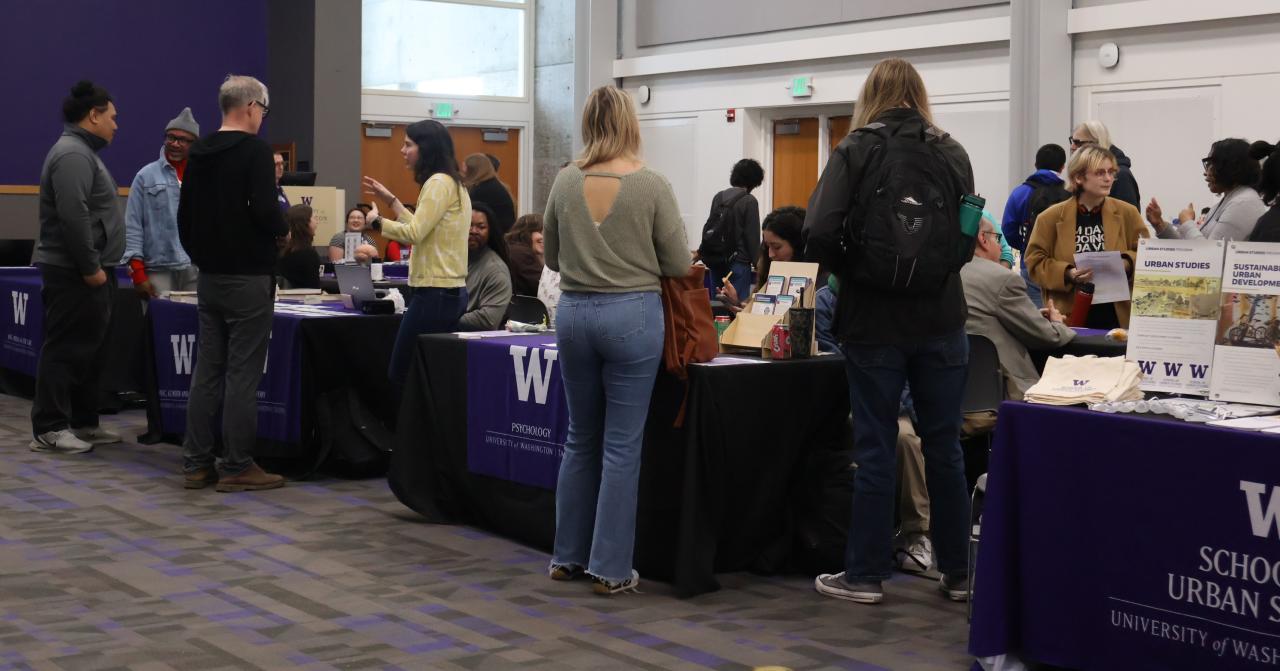
Time: 12:00 - 2:00 PM
Location: William Philip Hall (WPH)
Programs and Departments Participating:
- School of Engineering and Technology
- School of Interdisciplinary Arts and Sciences
- Milgard School of Business
- School of Nursing and Healthcare Leadership
- School of Social Work and Criminal Justice
- School Urban Studies
- School of Education
- Office of Global Affairs
- Institute For Innovation and Global Engagement
Option 3- Find Your Fit
Speed Exploration Sessions
Not sure which majors is right for you? Join a short, interactive exploration session designed to help you discover programs that match your interests and goals .
Time: 12:20-1:20 PM
Attend one (or more) of these sessions:
-
Protecting the Environment with Plastics Research
-
Building Communities with Urban Planning
-
Explore Education
-
Explore Engineering, Information Technology and Computer Science
-
Building Communities with Business Majors
-
Explore Creative Writing
-
Protecting the Environment with Pollution Awareness
-
Advancing Social Justice
-
Media Studies and Storytelling for Community Engagement
-
Explore Economics and Policy Analysis
-
Explore Mathematics
-
Understanding Culture through Media and Documentary Studies
 |
 |
If you have any questions, please contact the Office of Undergraduate Education (oue@uw.edu)
For disability access or ASL interpretation, please reach out to Disability Resources at least 10 business days in advance at 253-692-4508 or drsuwt@uw.edu